Assembly Democrats unite to tax software, health plans in revenue-raising package
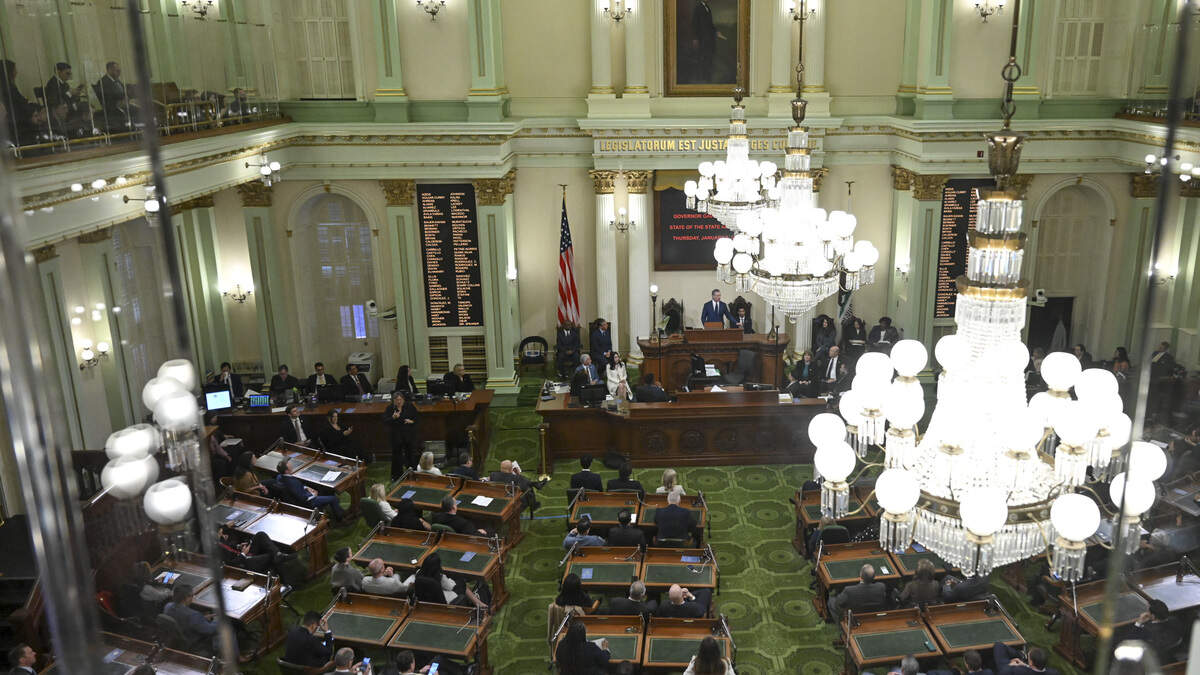
The California Assembly easily passed bills to increase taxes on software programs and health insurance premiums and extended a cap on corporate tax credits Monday, with the Democrat supermajority muscling in unity past Republican outrage during a late night debate.
Gov. Gavin Newsom first proposed the revenue raising measures in his May budget. Democratic leadership in the Legislature adopted them in an agreement announced last week. The California Senate is likely to echo the Assembly’s performance Thursday, leaving little space for industry lobbyists and other opponents to knock down the tax increases.
The bills, which could raise more than $3 billion in the coming fiscal year, are part of a budget package Democratic leaders say shores up the state’s social safety networks in the face of slashing cuts from President Donald Trump and the Republican-dominated U.S. Congress.
In the state Assembly, where Republicans hold 19 votes in the 80 member body, that party’s representatives accused California Democrats of abandoning their pledges to address the state’s cost-of-living issues.
“Californians are demanding relief right now, and what we are giving them are more taxes and more affordability,” said Assemblymember David Tangipa, R-Fresno. “And in a state that likes to claim that we are the richest state in the richest country in the history of the world, we still have an insatiable appetite for everybody else’s assets.”
Democrats also quickly dispatched with a Republican attempt Monday to suspend that tax, with several lawmakers from the majority party noting policies from President Donald Trump such as tariffs and the war in Iran had driven up inflation and gasoline prices.
The budget does not raise the state’s gas tax, but that tax is set to increase by 2 cents a gallon next month under laws that require adjustments tied to inflation rates.
Close a federal funding gap by taxing health insurers
But the budget deal is likely to increase monthly premiums for people with private health insurance. That’s because one of the most controversial tax proposals is a significant increase to the taxes paid by managed care organizations — the health insurers responsible for most commercial health plans.
Opponents of that measure estimate that tax could raise people’s premiums by as much as $100 a year for an individual or $400 a year for a family of four.
The measure drew fire from at least one moderate Democrat — Assemblymember Jasmeet Bains, D-Bakersfield, who recently lost a primary election to run for Congress. Bains, who often clashes with her caucus, accused California Democrats of having “lost the plot.”
The tax on healthcare plans was not “a progressive solution,” she said. “It is a cruel, regressive maneuver that mirrors the wort of Donald Trump’s attacks on healthcare.”
The federal government left the Legislature little choice but to raise the tax on managed care organizations, Assembly Budget Chair Jesse Gabriel, D-Encinitas, said. Republicans changed federal law to require an equal tax on private and public health insurance plans, negating a roundabout way California had used a tax on Medi-Cal plans to get more money from the federal government.
The state stood to lose out on billions more in federal funding, on top of all the other cuts in Republican’s federal budget, if elected officials didn’t raise the tax on private plans. The Legislature’s spending package, which Democrats passed earlier Monday night, includes money for hospitals imperiled by Trump’s cuts, as well as $300 million to subsidize Medicare premiums set to spike under a loss of federal subsidies.
“We are doing everything possible to protect health care for Californians, to make health care more affordable,” Gabriel said. “That’s why we’re working so hard to provide that premium support, we’re working so hard to protect our health care safety net. And in order to do that work, we need to pass this budget.”
But ahead of Monday’s vote, even some health access advocates who supported the tax increase noted there were likely other ways for the Legislature to raise the money without hiking private insurance premiums.
They pointed to two progressive proposals to raise money off corporations — one a change to how offshore companies are taxed and the other the imposition of a fee on companies whose employees rely on Medi-Cal for health coverage — that did not make the budget compromise.
The budget deal does include a measure requiring state agencies to study how many companies leave their employees to receive health coverage through Medi-Cal. But lawmakers have yet to vote on that measure, which is a legislative proposal that Newsom has yet to weigh in on.
Software sales tax, cap on corporate tax credit
In addition to the health insurance premium tax, the Assembly passed a measure to extend the state’s sales tax to software programs based on the cloud. Lawmakers also advanced a cap on a corporate tax credit designed to spur research and development. By 2029, removing that tax credit is supposed to raise the state as much as $4.5 billion a year.
Opposition to that measure is particularly fierce in the technology and biotech sectors. Advocates say tax breaks for research allow for the kind of expensive bets on innovation that have long driven California’s dynamic economy.
Removing the credit “inflicts lasting harm on the biotech sector and undermines one of the state’s greatest engines of innovation and economic growth,” said Sam Chung, a spokesperson for California Life Sciences, which represents pharmaceutical companies, medical technology companies and research centers, in a statement ahead of the Assembly vote.
Lobbyists for various trade associations have been working hard to kill or blunt the tax increase — but they’ve had little time to do so. Newsom unveiled the proposal in his May budget revision and lawmakers adopted it last week. With Democrat leaders all seemingly on board, the proposals have drawn support even from moderate lawmakers who initially appeared reluctant to increase any taxes this year. Bains was the only Democrat to vote against the tax measures Monday night.
On the floor, some lawmakers tied the tax credit to the nation’s rising wealth inequality and the fabulous wealth of tech billionaires.
The statute change “is so needed, not just in the entire architecture of a very carefully crafted budget,” said progressive Assemblymember Alex Lee, D-Milpitas, “but also to finally bring tax justice for all Californians and rein in the excess of greed, of corporations.”
This story was originally published June 16, 2026 at 4:25 PM with the headline "Assembly Democrats unite to tax software, health plans in revenue-raising package."