Meteors, micro moon and ‘city of stars’ to appear above California. Here’s when
From ancient stars to streaks of comet dust, there’s plenty in store for California skygazers in April.
Dazzling streams of shooting stars will light up the night sky when the ,Lyrid meteor shower returns in April, according to NASA.
Amateur astronomers can also spot a plethora of planets and a full moon during select cloud-free nights.
Here’s what to know about the upcoming celestial sights:
When to watch Lyrid meteor shower in California
In April, Earth will cross through paths of comet dust that comprise a springtime meteor shower, the Lyrids.
The Lyrid meteor shower was first observed by humans more than 2,500 years ago, according to historical Chinese texts.
The meteors originate from debris shed by the comet Thatcher, the online calendar Time and Date said.
According to NASA, the “modest meteor shower” will peak overnight on Monday, April 21, and continue into the morning of Tuesday, April 22.
You can catch shooting stars from 10:30 p.m. until dawn, with the most action occurring around 5 a.m., the space agency said.
What’s the best way to see shooting stars?
“For the best experience, face roughly toward the east, lie down in a safe, dark place away from bright lights, and look straight overhead,” NASA spokesman Preston Dyches said.
Californians can glimpse up to 15 meteors each hour under cloudless skies while the Lyrid meteor shower is underway.
The meteors can appear anywhere in the night sky, with some leaving vivid trails in their wake, NASA said.
How to glimpse ‘ancient’ cluster of stars in 2025
April is the best month to witness a globular cluster of stars known as “M3” in 2025, according to NASA.
“Hunt for the ‘faint fuzzy’ wonder that is the distant and ancient city of stars known as globular cluster M3,” Dyches said.
The collection of stars are about 34,000 light-years from Earth and estimated to be around 11 to 13 billion years old.
The M3 star cluster contains about half a million stars and can be spotted with the aid of dark skies and binoculars or a small telescope, the space agency said.
Through binoculars, the collection of stars look like a grainy, fuzzy patchwork of light.
With an 8-inch telescope, you can see hundreds of stars make up the cluster, according to NASA.
“M3 is an excellent target for beginners and seasoned observers alike,” Dyches said. “Whether using binoculars or a telescope, you’ll be rewarded with a view of one of the oldest objects in our galaxy.”
Which planets will be visible in night sky?
You can view Mercury, Venus, Mars, Jupiter and Saturn without using a telescope in April, NASA said.
Mars and Jupiter will be bright and visible to the naked eye the entire month, most easily seen in the first hours of evening darkness.
Mercury, the smallest planet closest to the Sun, can be seen in the later half of the month, around Thursday, April 24, and Friday, April 25.
Stargazers can catch the planet hanging low in the east just before dawn, according to the federal space agency.
Venus is visible throughout the entire month of April. You can catch it rising low in the east ahead of sunrise.
Saturn will be situated just below Venus in the final two weeks of April, according to NASA.
What’s the best time to see full moon in California?
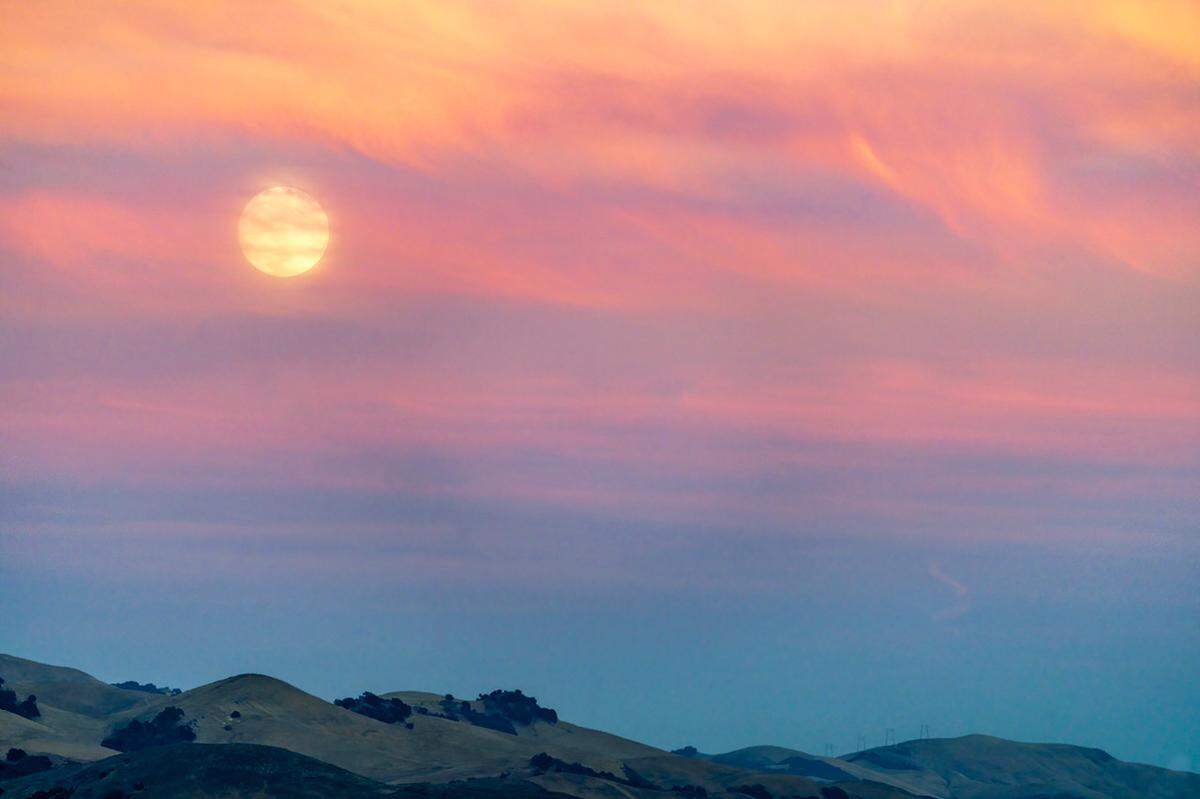
The fourth full moon of 2025 will reach peak illumination at 5.22 p.m. on Saturday, April 12, in California, according to Time and Date.
The April full moon is called the pink moon due to the blush-colored pink phlox wildflowers that typically pop up during the first full month of spring, Time and Date said.
Other names for the full moon in April include the breaking ice moon, sucker moon and budding moon of plants and shrubs, according to the Old Farmers Almanac.
April’s full moon also has a religious moniker, the paschal moon. This refers to its connection with the vernal equinox — the official first day of spring — and the Easter holiday.
“Easter is observed on the Sunday following the first full moon that occurs on or after the March equinox,” the Old Farmer’s Almanac explained.
Why is April’s pink moon called a micromoon?
April’s full moon is known as a micromoon because it will be at its farthest point from Earth.
The opposite of a supermoon, a micromoon appears as a slightly smaller and dimmer full moon in the night sky, the Almanac said.
This story was originally published April 3, 2025 at 5:00 AM with the headline "Meteors, micro moon and ‘city of stars’ to appear above California. Here’s when."