
Most California college students who qualify for ‘food stamps’ aren’t using them
Cheyann Wakefield was frustrated the first time she tried to apply for CalFresh, the social service formerly known as food stamps.
The Fresno City College student was denied when she tried applying while attending college less than half time. Then she reapplied while working 36 hours and attending college and was only eligible for $20.
“If I don’t have enough units or work enough hours, I didn’t qualify,” she said. “It just felt like a constant cycle to get out of poverty.”
It wasn’t until she could add her child to the case that her benefits became enough to sustain them, she said. It left Wakefield feeling like the service failed her.
“It doesn’t help the way it was designed,” she said. “I really felt like I was on this ladder going nowhere before having kids. Single individuals need as much help as parents when it comes to CalFresh.”
In recent years, California’s public colleges have begun taking action to address food insecurity and other basic needs to help students graduate, especially those from low-income households.
As part of their initiatives, the California Community College and California State University systems have identified ways to meet these needs, including opening food pantries and offering cooking classes, grocery gift cards, meal vouchers, and food delivery programs.
Making it easier for students to sign up and qualify for CalFresh, known federally as SNAP (Supplemental Nutrition Assistance Program), remains one of the biggest challenges for schools, which have implemented outreach programs to help students like Wakefield. Eligible students could receive up to $250 a month to purchase grocery items.
Yet, most students who qualify for CalFresh are not using it because of the stigma around using “food stamps” and the barriers to signing up, according to a 2020 report from the California Department of Social Services.
Although it remains difficult to quantify just how many students are using the program, a state estimate put the number at about 127,000 a year. The number of students who likely qualify is between 416,000 and 689,000.
‘Extra barriers’ to CalFresh
At Fresno City College, Student Activities Director Ernie Martinez prescreens students who come to the Ram Pantry, the food pantry that’s open three days a week. Some end up signing up for CalFresh without any help and others are directed online to a 10-minute application form.
He was able to help 17 students apply in October and eight in September, he said. The college is using grant money for outreach and marketing of CalFresh eligibility.
“It allows us to hire people dedicated to making sure that the word gets out,” Martinez said. “What we really do is inform them of the different eligibility criteria.”
Anyone applying to CalFresh must meet an income requirement, but “students have extra barriers,” according to Ravin Craig, the coordinator for the CalFresh Outreach Program at Humboldt State University.
A student must attend school at least half time and work at least 20 hours a week to qualify, Craig said. Compounding that is many colleges cap the number of hours a student can work if employed by the school at 19 hours. If a student doesn’t meet the work hour requirement, they can qualify with other exemptions:
- Be approved for work-study and not refuse any assignments
- Receive a Cal Grant A or B
- Be a full-time student and a single parent to a child under 12
- Be a part-time student with a child between 6 and 11 without adequate childcare
- Receive CalWORKS benefits
- Be enrolled in a job training program accepted by CalFresh
- Plan not to attend college in the next term
Craig said, during the pandemic, some new temporary exemptions were added, including having an expected family contribution of $0 when filling out the Free Application for Federal Student Aid, or FAFSA.
“I think the hope really from everybody I’ve talked to is that those exemptions will be accepted as permanent,” she said. “As soon as the exemptions were in place, I went back through, and we contacted students who had been denied and now met qualifications to have them reapply.”
A new law is also attempting to clarify and strengthen some of the exemptions. Authored by Assemblyman Jesse Gabriel, D-Woodland Hills, AB 396 would require a program at each CSU and community college that fulfills the job training program exemption. The law would also clarify the application and approval process so more programs may qualify.
Some programs are already universally qualified at campuses, such as the Educational Opportunity Program (EOP), Disabled Student Programs and Services (DSPS), and some foster youth programs.
Using SNAP and EBT on campus
Craig has been working with the Oh SNAP! Student Food Program since 2015. Humboldt State was one of the first colleges to introduce a food bank on campus when it did so in 2013 and has spearheaded the movement on addressing student food insecurity.
The CSU has tracked its progress at each campus to solve the food insecurity problem. As of April 2021, all 23 campuses have a food pantry and help students enroll in CalFresh. But both CSU and California Community College campuses lag when it comes to one metric — allowing students to purchase food on campus using their SNAP benefits.
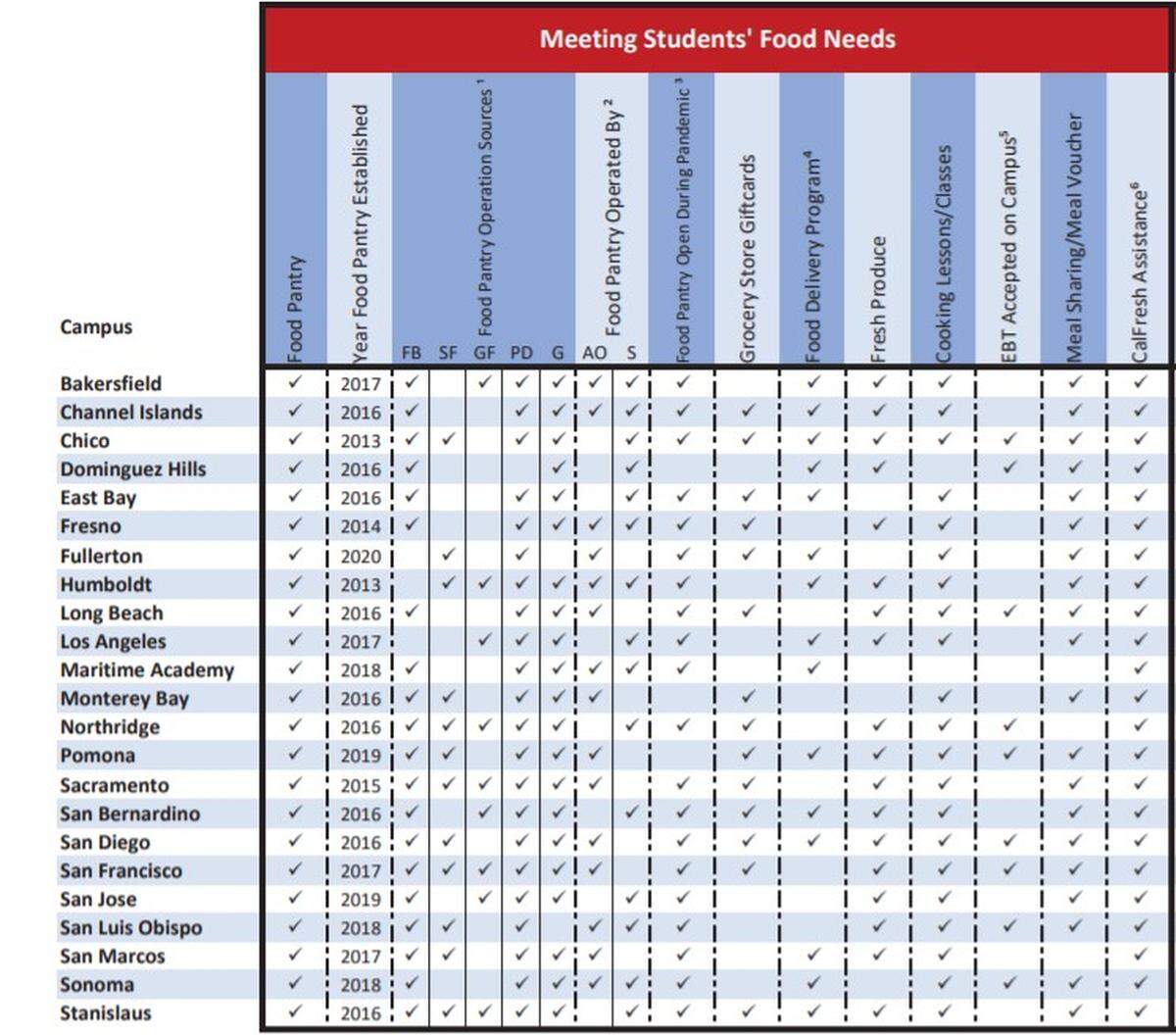
There are 10 California Community Colleges and nine CSUs that allow students to swipe their electronic benefits transfer card — known as EBT — at cafeterias or food stores on campus. Several community colleges are working to establish programs to allow students to use SNAP benefits for food. Still, none of the central San Joaquin Valley colleges are currently accepting SNAP benefits for food.
Part of the problem is that SNAP benefits are only eligible for non-hot food items, and cafeterias mostly serve hot food. The California Community College Chancellor’s Office released a guidebook that helps campuses understand how cafeterias or food stores can become eligible to accept SNAP.
It’s not easy.
Vendors must sell at least three items from four categories: fruits and vegetables, meat; poultry or fish; and breads and cereals. At least three items in two categories must be perishable. A vendor could also qualify if more than 50% of its gross retail sales come from the sale of staple foods, but that’s more common for vendors who focus on one type of item, such as butchers.
Vendors might also need to update their point-of-sale technology to accept EBT cards and allow a USDA inspector to confirm everything in the application is correct.
Martinez, the student activities director at Fresno City, said that before the pandemic hit, the college was working with the cafeteria to get approved. The cafeteria only recently reopened again, and “those conversations haven’t started back up yet,” he said. “But yes, we’re looking into that.”
Many cafeterias are run privately through contracts, presenting an added barrier in working with colleges. Humboldt State’s dining management changed this year, Craig said, and the school is attempting to reapply and have CalFresh accepted on campus again in the spring.
Can colleges better address food insecurity?
Colleges are finding unique ways to address student hunger. Fresno City College’s food management class has been teaming up with the Ram Pantry once a week this fall to give away meals that are created in the classroom.
Student Kalana Sawyer, who picked up a to-go meal on a Thursday, said the free food is helpful.
“I don’t have enough money (and) this helps me get food for the day whenever I’m at school,” she said.
Craig, from Humboldt, said her campus was pushed to react because of a great need. In 2018, the school estimated that 19% of its students used CalFresh, indicating a high level of food insecurity.
“It’s very different up here than it is in other places in California,” Craig said. “It’s very rural. It’s not like San Francisco or Fresno, or LA. There’s just not as much infrastructure here.”
She said the community has limited resources to offer its residents, “so as an institution, we have to make sure and fill those gaps.”
When attempting to solve problems, colleges may face obstacles, such as storing and distributing food and meeting health codes safely. Craig said campus space might also be an issue, and it may take time to sort through it all and make pantries and other food services work.
Craig has made it a habit to meet regularly with the county social services office to stay up to date on guidance and get staff training.
She said stigma and fear over using CalFresh is also a problem within the community and students themselves.
She said the belief from the community “that students don’t need these resources, that students have money, they have parents’ support” is based on an outdated idea of who college students are.
“The demographics for what a college student is are very different than they were in the 90s or early aughts,” she said. “And that means we need to expand the resources to make sure everybody has an opportunity to get an education.”
Campuses should try to remove as many barriers as possible to accessing resources, Craig said. That includes having to prove, by paperwork or other means, that they actually need the resource. At Fresno City, students usually need an ID number to access the Ram Pantry, but not a student ID card, which costs money to purchase.
Some students may not want to apply because their family members are trying to get a green card, Craig said, and policies fluctuate. Though as of March, the public charge rule the Trump administration put in place has changed, and SNAP is touted as safe.
“There are students who don’t want to apply because they don’t think they deserve the resources,” she said, “and students sometimes don’t apply because it is seems like a complicated process, and it can take time.”
Craig said following up to make sure students went through with interviewing and sending in documentation is important.
“(It’s) kind of holding their hands through each step and then at six months when they have to recertify their information, making sure that they have access to getting that information to the county and that they know what they have to do.
“Paperwork can be scary, and phone calls can be scary, and a lot of people struggle with navigating those things.”
Creating a student-driven culture to reduce stigma can help too.
Students making the decision about what kind of items are in stock at pantries and helping CalFresh outreach are big ways to change minds, she said.
“The food pantry (at Humboldt State) is not like what you would think of as a typical food pantry,” she said. “It’s like a place where people come to hang out, and get a cup of coffee and talk to people, and also apply for CalFresh. So that vibe in the space has been incredibly helpful. And it’s all student-driven.”
The Education Lab is a local journalism initiative that highlights education issues critical to the advancement of the San Joaquin Valley. It is funded by donors. Learn about The Bee’s Education Lab on our website.
This story was originally published November 23, 2021 at 5:00 AM with the headline "Most California college students who qualify for ‘food stamps’ aren’t using them."