Is it safe to open California? Why there’s optimism despite past COVID reopening setbacks
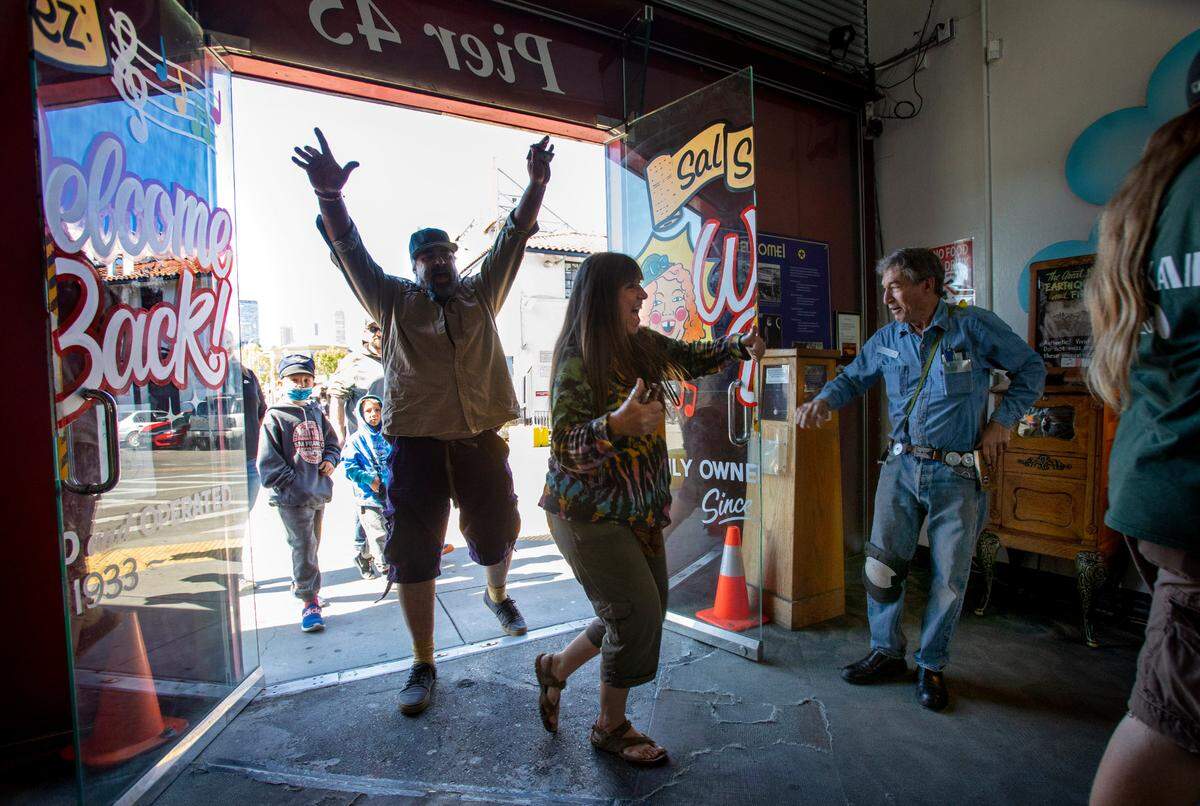
California is open. Like, for real this time.
On Tuesday, Gov. Gavin Newsom and the state lifted most COVID-19-related business closures, capacity limits and social distancing requirements. Masks are no longer required for those who are fully vaccinated in many settings. And most of the few remaining restrictions pertain to “mega” events — those with crowds of thousands of people.
The state’s first two attempts at gradual reopening from the coronavirus shutdown failed.
After closing the economy with a stay-at-home order in March 2020, the Newsom administration first instituted a phased approach in May 2020, allowing certain industries to wade back into reopening. By that June, bars and restaurants in many parts of the state were allowed back open.
But COVID-19 infections began to spike, the 2020 summer surge began and most restrictions that had been dropped were quickly re-imposed by mid-July.
Newsom and the state health department then, at the end of August as cases were again declining, introduced a new, color-coded system — the “tier” framework for assessing counties’ risk levels, which ended Tuesday.
The framework began smoothly in its first two months, but by early November, an even worse surge began to take hold, prompting the governor to pull an “emergency brake” — plunging virtually all of California for the next two months into the tightest restrictions since the start of the crisis.
Despite those prior disappointments, state and local health officials — and the governor — seem fairly confident that this will be the time that reopening sticks.
“I have high hopes that this summer is going to look very different than it did in 2020,” California Surgeon General Dr. Nadine Burke Harris said last week during a vaccine clinic in Kerman.
Here’s why health leaders are optimistic.
Millions are vaccinated
The most obvious and important difference between this reopening campaign and previous attempts is that Californians now have wide access to highly effective COVID-19 vaccines, which were authorized for use in the U.S. in December.
More than half of the nation’s most populous state has had at least one dose.
Since the Pfizer and Moderna two-dose mRNA vaccines were cleared for use six months ago, 48% of California’s 39.5 million residents have been fully vaccinated and 57% are at least partially vaccinated, according to data from the California Department of Public Health.
Just over 70% of California adults are at least partially vaccinated — President Joe Biden’s July 4 goal for the United States.
Both clinical and real-world data show that protection from the available vaccines is substantial.
In Sacramento County, home to nearly 1.6 million people, the local health office has reported just 369 positive cases, 129 of whom have been symptomatic, out of 644,000 residents classified as fully vaccinated as of last Friday. That’s one symptomatic “breakthrough” case for about every 5,000 vaccine recipients.
Virus activity trending down, even as reopening progresses
CDPH reports several of California’s most important COVID-19 metrics at their lowest points since monitoring began in early 2020.
Test positivity, which health experts use as an indicator of spread of the virus, was reported Tuesday at 0.7% over the past week, which matches California’s all-time record low. The weekly rate has remained below 1% since early May.
In late May 2020, when restrictions were loosening for the first time, positivity was over 6%, CDPH data show. Late August, when the tier structure was announced, it had dropped to 5% after spiking to nearly 10% during the summer surge. During the worst of the winter surge, it topped 17%.
Sacramento County had a plateau in COVID-19 cases that made it one of the state’s last counties to exit the tighter red tier of restrictions.
But cases are once again dropping locally, falling from 6.8 daily to 3.8 daily cases per 100,000 residents over the past month, according to the local health office. Test positivity was 1.8% last week, the county’s lowest weekly rate in almost a year.
“I think we’re really happy with the direction that case rates are going,” county epidemiology program manager Jamie White said last week. “We’re pretty happy with our progress, especially over the past couple of months.”
The statewide and local declines in COVID-19 rates are happening even as restrictions have loosened gradually over the course of this spring.
Dr. Aimee Sisson, Yolo County’s public health officer, in the past has been critical of California’s reopening path. She disagreed, for instance, with the state’s decision earlier this year to loosen case metric thresholds within the tier system on the basis of the state reaching vaccine milestones.
“When we get impatient with COVID is when we get into trouble,” she told The Sacramento Bee in March.
But, three months and millions of vaccinations later for California, Sisson isn’t expressing the same concern, at least for her county, which has a vaccination rate very similar to the statewide average.
“With our local case rate very low and the majority of Yolo County residents vaccinated, now is an appropriate time to loosen COVID-19 restrictions,” Sisson said in a prepared statement Tuesday.
Far fewer patients in hospitals
The number of patients hospitalized with COVID-19 across California has plummeted, dropping last week below 1,000 for the first time since CDPH began tracking the total. As of Tuesday, it was at 977, including 251 in intensive care units.
At the end of May 2020, there were about 3,000 hospitalized including more than 1,000 in ICUs, and in late August when the tiers were introduced, nearly 4,000 with about 1,200 in intensive care.
During the peak of the hospitalization surge in January, nearly 22,000 patients were hospitalized at once, including almost 5,000 requiring intensive care.
Restrictions aren’t entirely gone
Masks are still required for those who are not yet fully vaccinated, as well as in a number of settings with susceptible populations or higher likelihood of spread.
Those exceptions include nursing homes, prisons, K-12 schools, public transportation, homeless shelters and emergency shelters.
And at indoor “mega-events” with more than 5,000 attendees, guests are required to show proof of vaccination or a negative test for COVID-19 before entry.
Counterpoint: Low-vaccine areas, looming threat of variants
Concern is low, but still exists.
Health officials’ remaining worries generally center on demographic populations and geographic areas with low vaccination rates. There’s interrelated concern about existing or new genetic variants of the virus that could wreak havoc on the unvaccinated or, in the worst-case scenario, evade vaccine protection.
Consider how widely vaccination rates vary across California’s 58 counties: more than 75% Marin County residents have had at least one dose, compared to under 25% in Lassen County, according to CDPH. Nearly all of the most vaccinated counties are in the Bay Area, while nearly all of the least vaccinated are rural areas.
As for variants, the United Kingdom just one day before California’s reopening officially postponed its own, initially set for June 21, by four weeks due to the growing presence of what the World Health Organization has denoted the “delta” variant (B.1.617).
The delta variant has been detected in the U.S. including close to 300 cases in California as of last week, CDPH reported, but the state has not as of mid-June reported a spike in overall COVID-19 cases like the U.K. has observed. California and the U.K. currently have fairly similar vaccination rates, but they also had different strategies in distribution in terms of age groups and the delay between first and second doses.
Time will tell whether delta or any other variant fuels a resurgence of cases in California, but as of Tuesday, California’s day of grand reopening, there’s nothing to suggest cases are trending up.
“We need to keep our guard up,” Newsom said Tuesday morning during a news conference outside Universal Studios, where he was set to announce the 10 $1.5 million grand-prize winners in the “Vax for the Win” vaccine lottery.
Ultimately, health experts say, it all comes back to vaccination.
“While the blueprint framework is ending today, the pandemic is not,” Sisson, the Yolo County health officer, said in her Tuesday statement. “Those who are not yet vaccinated remain at risk of infection and should continue to protect themselves and others from COVID-19 by wearing masks indoors.”
This story was originally published June 15, 2021 at 12:04 PM with the headline "Is it safe to open California? Why there’s optimism despite past COVID reopening setbacks."