
Drought hits Central Coast sod growers hard
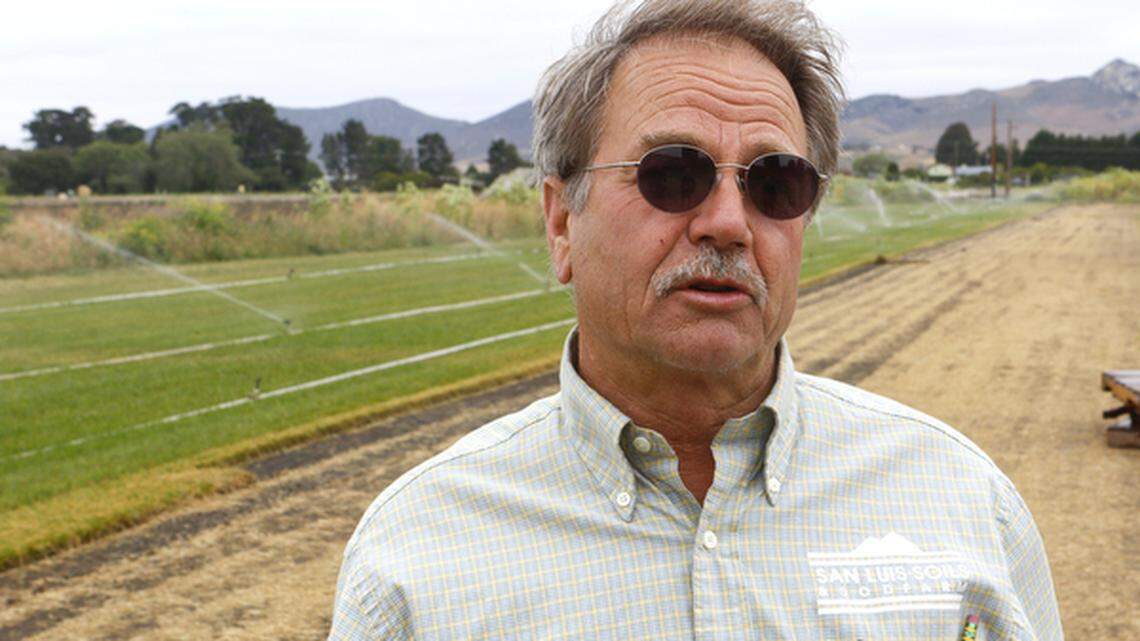
As San Luis Obispo County suffers through its fourth consecutive year of drought, local sod growers are taking a financial hit as many of their customers let their lawns turn brown and replace them with other landscaping.
“Nothing’s got easier; I’ve never worked this hard in my life,” said Bill Kostik, owner of San Luis Soils and Sod Farms in Los Osos. “We just keep working longer and harder for less.”
Kostik, who started the farm 35 years ago, said he’s only selling about 5 percent of the sod he did before the drought. Once farming almost 30 acres, San Luis Soils and Sod Farms is now down to 10.
For the first time in 30 years, Kostik didn’t reseed any fields this year, he said; his entire crop remains on hold. He estimates that he has $100,000 of sod inventory on hold. Sod can be held for about three years.
“It’s what gets you through,” he said.
Kostik said he’s made it because he diversified his business from the start, selling specialty soil, cobblestone, mulch, bark and rock in addition to sod. Since the drought began, income from sod has been nonexistent, he said.
The income from lawn substitutes has remained steady and made it possible for Kostik to pay the bills, his two part-time employees and himself, although he said there isn’t any room for luxuries.
“You still have to service the same debt service, insurance is the same, permits and licenses stay the same, overhead and employees,” he said. “The costs all stay the same, but your income is less.”
Central Coast Sod, a large sod farm in Santa Maria, has also seen a decline in business; its total annual sales have dropped 30 percent from the previous year’s sales. Its approximate total sales last year were $900,000. Ninety-five percent of its business is selling sod; the other 5 percent is from seed and fertilizer sales.
Monica Rodriguez, office manager for Central Coast Sod, said that before the drought, the economy took a dive, which meant people weren’t doing construction and putting in turf.
Once the economy began to improve, the drought began.
“It’s just been an ongoing type of battle,” Rodriguez said.
Before the drought, Central Coast Sod was planting 100 acres of sod; now, it has reduced its crop to nearly half that, planting 60 acres.
Linda Steward, owner of Steve Schmidt Topsoil Inc., a Paso Robles company that sells landscaping materials, said, “Sod is not something we make a lot of money on.”
She has seen a definite increase in bark and rock sales as people take out big lawns and replace them with low-water landscaping.
Steward said most sod companies are focusing on drought-tolerant grasses, such as dwarf fescue, a particularly hardy type of grass sometimes called “Cuesta Highland” on the Central Coast and marketed to customers who live over the Grade because of its extreme heat tolerance.
Steward’s biggest concern is what will happen next.
“Now, people are interested in tearing up big lawns and putting in little ones or replacing them. What happens after that?” she asked.
This story was originally published June 1, 2015 at 9:47 AM with the headline "Drought hits Central Coast sod growers hard."