
Have you ever taken on a Big Pointless Goal? Try learning to use an abacus
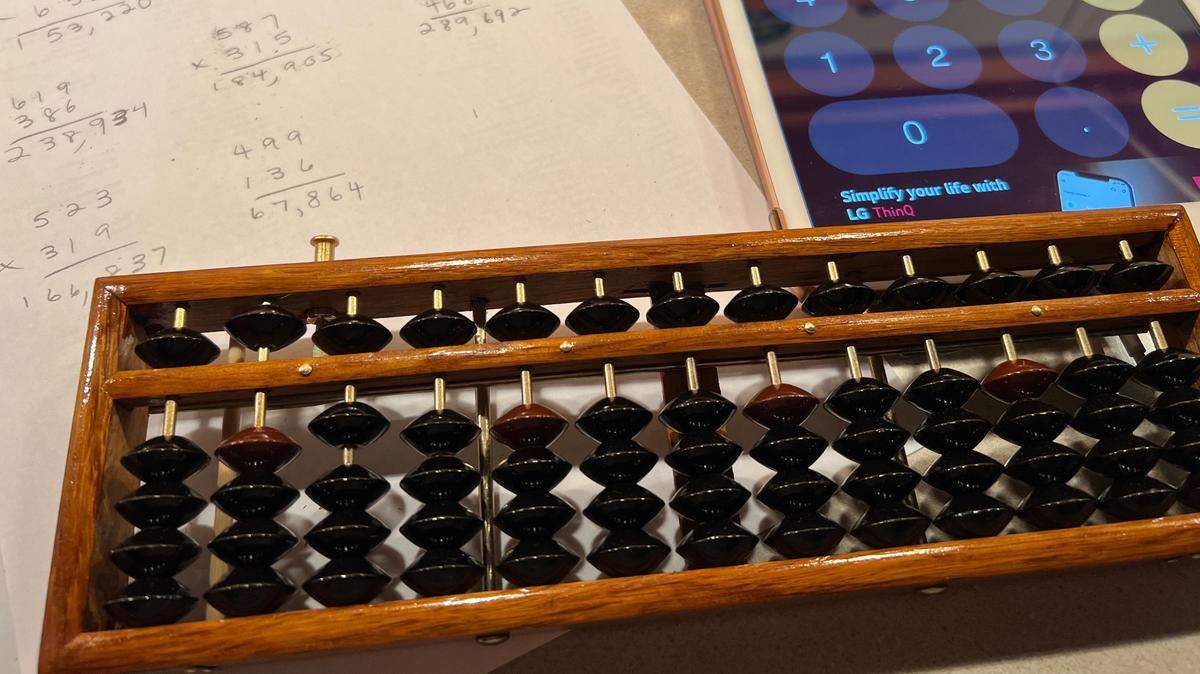
In my ongoing quest to master new skills and stay current with technology, I’ve taken up a new hobby — learning to use an abacus.
OK, it’s not what you’d call cutting edge. According to Wikipedia, the Sumerians were using framed racks of beads to compute figures as early as 2700-2300 B.C.
But it’s new to me. And it was state of the art at one time. So, it satisfies both my personal requirements.
The learning curve has been meteoric. When I started, I could identify an abacus in a picture. That was it. I had zero idea how it worked and even less understanding of how to use one.
Now, after weeks of endless YouTube tutorials (Miss Abacus, you are my hero!) and spending hours scratching my way through worksheets, I’m multiplying three-digit numbers — and sometimes arriving at the right answer.
I’m in the process of achieving a Big Pointless Goal, what Gloria Liu describes in her recent article in the Atlantic as “an aspiration that lacks grand purpose, yet requires substantial effort to attain.”
She writes that we live in a results-driven culture and view every action under the self-improvement microscope. Yes, morning spin classes on your SoulCycle will likely improve your cardiovascular fitness. But it blanches out an equally key component of well-being: pleasure.
Pointless goals, on the other hand, are nothing but pure enjoyment.
We throw ourselves into the pursuit because we want to, not because there’s anything to be gained.
I spent so much time playing with my abacus that I’d ashamedly lock my door to avoid any “Are you in there again?” dirty looks.
The pursuit of a pointless goal frequently baffles our friends and loved ones. They quizzically ask, “Why in the world would you do that?” “Don’t you have anything better to do with your time?” But the answer is always the same. We do because it’s fun. The activity scratches some internal, emotional itch that we may not be able to explain but motivates us nonetheless.
Any activity can qualify as a Big Pointless Goal. Growing a 400-pound pumpkin, virtually hiking the Camino de Santiago or learning to speak Mandarin could all fit the bill as long as there’s nothing inherently to be gained.
To be fair, Big Pointless Goals do have redeeming value. For instance, they give us purpose.
I had to decide which abacus to order and find a YouTube teacher I could understand and wanted to follow.
Lots of thought went into the process even before I embarked on my lessons.
Big Pointless Goals are good for brain health. Research shows that learning something new improves cognition, memory and adaptability. It also decreases stress and increases feelings of self-worth and competence.
Finally, Big Pointless Goals make us more well-rounded. Whether we can now recite the alphabet backwards or complete the Sunday New York Times Crossword Puzzle, we’ve mastered a skill and accomplished a goal.
We’re different than we were when we started. And we had tons of fun along the way.