
The soul of a culture on display
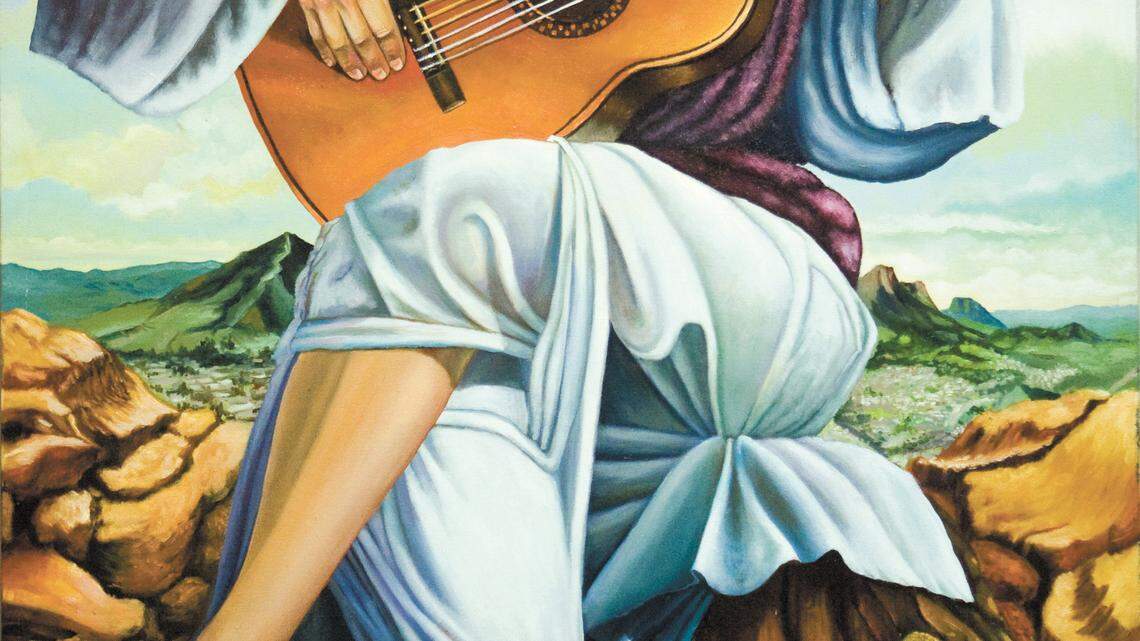
The English language skills of some featured artists in the Latino exhibit may be weak, but their work cuts across such barriers.
Of the seven artists featured in the San Luis Obispo Arts Council’s show, all but one were born in Mexico.
El Morros, the range of extinct volcanos stretching along Los Osos Valley Road, serves as a background for a Carlos Diaz oil painting of a woman playing guitar to a rattlesnake.
Speaking through an interpreter, Diaz explained some of the meaning and symbolism in his painting. The model is a former girlfriend, he said, and she’s playing in the key of sol, which has a double meaning, as “sol” means sun in Spanish.
“It’s like a poem that she’s singing,” he said. Her smile is tender, considering it’s aimed at a deadly creature, and “she’s not afraid, because she’s charming the snake,” said Diaz, who noted that the snake in Mexican and pre-historical Latino culture symbolizes knowledge and ability.
Diaz, 41, was born in Guanajuato and moved to San Luis Obispo 11 years ago. He studied art in Mexico, and has been in numerous group shows in Mexico and California, and some local solo exhibits.
All of the artists in the exhibit live on the Central Coast, from San Luis Obispo to Santa Barbara. Their media ranges from painting to drawing to ceramics to mixed media.
Santa Barbara artist Maria Rendon, born and raised in Mexico City, realizes how important hands are to an artist and often uses them as themes in her work. She had a sharp lesson in their importance when she sliced off a finger with an electric saw while cutting an altar-like construction titled “Ten Steps.” Her “Crocodile Tears” shows a child with a missing digit, as Julie Frankel pointed out. Frankel helped assemble the show with the curator, Enedida Castane da, a poet and co-host of the Santa Maria television art program “Where Creative Minds Meet.”
Joshua Solis of Guadalupe is also from Guanajuato, whose culture and traditions greatly influenced him, as did his father, a selftaught painter. Solis did a self portrait in charcoal for the show, along with a subtle nude.
Born in the United States, Valinda Gallea of Arroyo Grande chose a traditional painting for the show, a watercolor of a mother and child wrapped together in a bright blue blanket. When her parents realized her drawing talents when she was barely a year old they saw to it she received art instruction starting at age 3. Gallea has since worked on countless school murals to encourage children to appreciate art.
Stone sculptors include Pedro Paez Navarro and Alvaro Angeles Suman, who has offerings in other media as well.
The exhibit is called “Sabor,” which means taste in Spanish, but on another level it means “the soul of a culture,” according to Castaneda, providing guests with the artists’ talents and spirited expression.
This story was originally published November 14, 2011 at 4:56 AM with the headline "The soul of a culture on display."