
'Signal Hill Speed Run' doc celebrates downhill daredevils
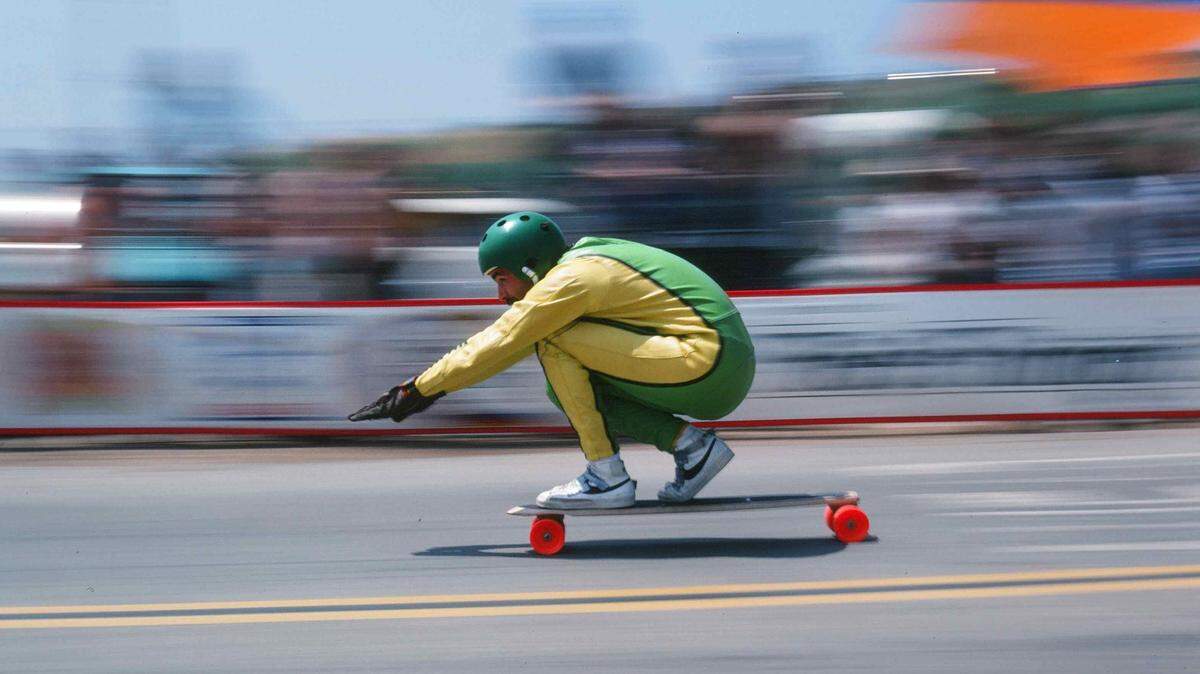
For Southern California skateboarding enthusiasts in the 1970s, Signal Hill represented the Mt. Everest of racetracks.
Careening down that tall, steep slope at upwards of 50 miles per hour, “It looked like you were on a roller coaster going straight down into hell,” one competitor recalls in the documentary “The Signal Hill Speed Run.” Another racer equates plunging down Hill Street to surfing big waves in Hawaii’s Waimea Bay.
Directed by Jon Carnoy and Michael Horelick, and written by Horelick, “The Signal Hill Speed Run” takes its title — and its subject — from the event that effectively launched downhill skateboarding as a sport. The 90-minute film, narrated by singer-songwriter Ben Harper, combines vintage footage and photos with interviews with race organizer Jim O’Mahoney and several of the daredevils whose death-defying feats stunned onlookers and inspired athletes everywhere.
The city of Signal Hill gets its name from the 365-foot peak once used by Tongva tribe members for signal fires that could be seen as far away as Catalina Island.
Surrounded by oil fields, Hill Street originally served as the site of the Model T Hill Climb. But in 1975, after being approached by the producers of ABC’s “The Guinness Book of World Records” about organizing a televised skateboarding competition, O’Mahoney selected the vast stretch of bumpy asphalt as the site of the first-ever Signal Hill Speed Run.
Only two competitors took part in the race on Oct. 17, 1975: Greg Grundy and Garrison Hitchcock. After Hitchcock was hauled off by ambulance with a broken wrist, Grundy completed his run and set the world’s first downhill skateboarding record, clocking in at 50.2 mph.
The following year, thousands of spectators showed up to watch 23 competitors try their luck.
As “The Signal Hill Speed Run” reveals, the race led to various innovations during its four-year run — ranging from the creation of street luge by burly longshoreman Sam Puccio to the development of the “Hut Tuck” technique modeled by John Hutson after downhill skiers. Initially closed to women, the Signal Hill Speed Run welcomed its first female competitors in 1977.
The race also saw the introduction of “skatecars” — fully enclosed, gravity-powered vehicles created exclusively for downhill skateboarding events. Although their streamlined designs enabled competitors to reach before-unattainable speeds, the documentary shows, skatecars were considered “rolling coffins” due to their propensity to fly out of control — endangering athletes and fans alike.
“The Signal Hill Speed Run” dedicates much of its runtime to the extreme risks racers took to compete for only $1,000 in prize money. But it also touches on the unmistakable allure of the sport.
“It didn’t really matter to me to win,” acknowledges Dave Dillberg, a steely Vietnam War veteran turned surfer and skateboarder. “I just wanted to go fast.”
If you go
“The Signal Hill Speed Run” screens at 7 p.m. Saturday at the Palm Theatre, 817 Palm St. in San Luis Obispo, as a benefit for the Morro Bay Skateboard Museum. Past race competitors including museum owner Jack Smith will participate in a question-and-answer session following the film, which is unrated but contains some adult language and drug references.
Tickets are $10, or $25 with a Morro Bay Skateboard Museum T-shirt.
For information, call 610-3565 or email jack@theskateboardersjournal.com.
This story was originally published November 20, 2014 at 12:51 PM with the headline "'Signal Hill Speed Run' doc celebrates downhill daredevils."