
Samite uses his music to promote peace, understanding
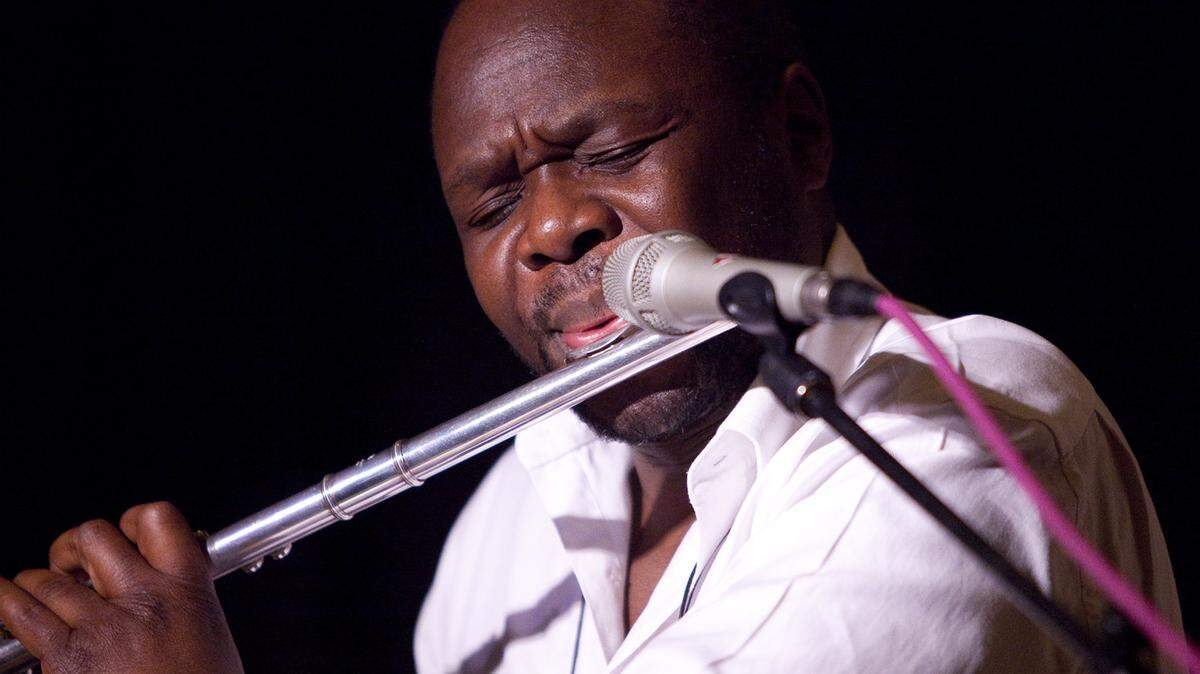
During a visit to war-ravaged Rwanda, Samite Mulondo remembers being approached by a glassy-eyed child.
“He wasn’t showing fear. He wasn’t showing excitement. He was just emotionless,” recalled the soft-spoken musician, who goes by “Samite” professionally. “When I started playing, the kid’s eyes came alive.
“Soon I had 20 kids around me playing drums and singing and telling their stories. That’s when I realized the healing part of my music.”
Samite, who performs Thursday in San Luis Obispo, knows firsthand about music’s ability to lift the spirits and soothe the soul. Forced to flee his native Uganda in 1982, he rediscovered a connection to his homeland through traditional African music and instruments such as the kalimba (thumb piano), litungu (seven-stringed lyre) and endere (flute).
Ask Samite, 57, about his earliest musical memories, and he immediately mentions hearing court musicians perform at the Lubiri, or, royal compound, near Uganda’s capitol city, Kampala.
“Every day, I’d hear these multi-layered instrumentalists playing these songs” in the time-honored Ugandan style, recalled Samite, whose maternal grandfather was also a talented musician. “That for me was the foundation of my love for music.”
As a teenager, he discovered Western music and helped found the Mixed Talents, a band that performed contemporary hits.
“People just went crazy hearing these young kids singing Western music,” the musician recalled. “It was kind of fun.”
Unfortunately, the band’s rising popularity coincided with a time of political unrest and violence in Uganda.
“You’d be driving with your friends and people would shoot at you with an AK-47. People would be kidnapped,” said Samite, whose oldest brother, an accountant, was kidnapped, tortured and killed by government forces. “If there was a doubt by those paranoid soldiers that you (were) involved in anti-government forces, you would actually disappear overnight and you would not be seen again.”
One incident in particular motivated Samite’s decision to leave Uganda.
One day, while he was having his shoes polished by a street vendor, two police officers walked up behind him. “Usually that meant this was the end,” Samite said.
“In my mind, I was thinking I’m not going to be kidnapped like my brother. I’m going to die on this street,” recalled the musician, who decided to attack the officers rather than risk arrest. But it turned out the cops were just organizing traffic for a Mixed Talents concert.
“At that moment, I knew I just (couldn’t) take this anymore,” he said. “I pretended I was going to visit Kenya and didn’t come back.”
It was there, while playing saxophone for the African Heritage Band, that “I started reaching back to the traditional music. … I started to remind myself of what I heard as a little kid in the palace,” Samite said. As he pieced together his memories using traditional instruments sent by his family, he developed his own style of singing and playing.
Also while in Kenya, Samite met the American woman who would become his first wife, Joan. They moved to the United States in 1987, eventually settling in upstate New York.
Over the years, Samite has released nine albums, including 2012’s “Trust,” and composed the soundtracks of the documentaries “Addiction Incorporated” and “Taking Root: The Vision of Wangari Maathai.”
In addition, Samite was the subject of the 1998 PBS documentary “Song of the Refugee,” which saw the musician returning to Africa “to share my music and tell stories about what was really happening,” he said.
People in Liberia were initially angered by the presence of cameras, he recalled.
Then, during one stop, “I pulled out the flute and the kids in this refugee camp came out and surrounded me,” he recalled, soon joined by their mothers. Before long, everyone was singing and playing.
Those experiences inspired Samite in 2002 to found Musicians for World Harmony, a nonprofit organization that uses music to promote peace and understanding around the globe. In addition to organizing service-learning trips for Berklee College of Music in Boston, he’s traveled across Africa and Eastern Europe to work with AIDs orphans, former child soldiers, rape survivors, refugees and others.
He’s also used music to connect with those living with dementia and Alzheimer’s disease.
“Music brings hope. It brings us promise,” Samite said. “I’ve seen it happen so many times. … Sometimes it brings back, just for a moment, the time when things were not so difficult …”
An avid photographer, Samite also uses his lens to tell people’s stories.
“I try to show them as who they are … happy, loving, caring people,” he said. “Even though they’ve lost their loved ones, there’s still that spirit there.”
Samite
7:30 p.m. Thursday
Pavilion, Cal Poly
$27.20 to $34
756-4849 or www.pacslo.org