
Cal Poly professor John C. Hampsey’s new memoir explores his boyhood in the 1960s
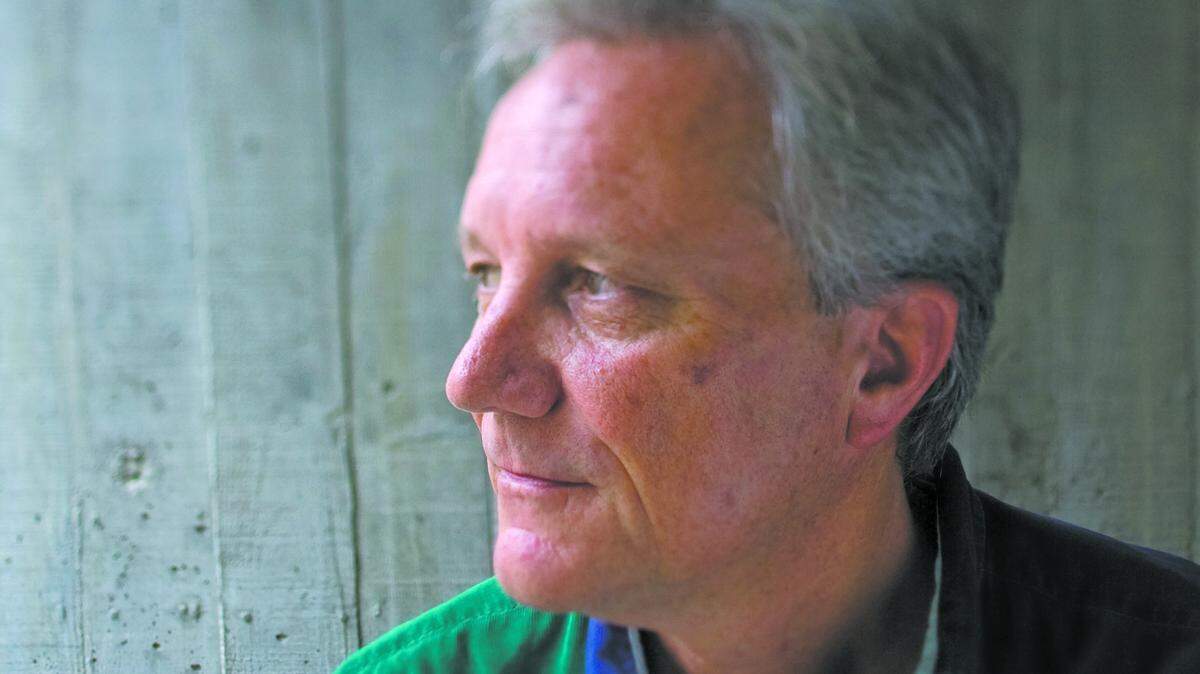
In Cal Poly professor John C. Hampsey’s new memoir, Kaufman’s Hill rises like a mythical monolith.
Located in Mt. Lebanon, Penn., the crown vetch-covered slope is the site of countless boyhood adventures, of cruelty, courage and sexual awakening. It’s the kind of landscape that looms large in the imagination.
“It’s almost like we built an altar of our past and it has great sentimental value, but the altar keeps shifting as we get older and older,” Hampsey, 60, said. “Time passes and we reshape it and it gets more distant but somehow more meaningful.”
“Kaufman’s Hill,” which will be released Feb. 1 by Bancroft Press, details the author’s experiences growing up in a middle-class, Irish-Catholic family in the Pittsburgh suburbs. The narrative follows Hampsey from age 7 to 14, beginning in 1961 and ending in 1968.
The youngest of five children, Hampsey endures run-ins with neighborhood bullies and abusive adults, grapples with his burgeoning sexuality and his flailing faith, and struggles to understand his distant father, an embittered lawyer who turns to bourbon highballs and getrich-quick business schemes to drown his disappointment. (“He’s really a King Lear tragic figure in the book,” the author said.)
His mother, in comparison, is portrayed as a gentle, grey-haired woman who takes pride in her son’s art education and relishes simple pleasures such as sipping her nightly beer while listening to the rain patter on the porch roof.
In contrast to the sensitive and at-times timid Hampsey is Taddy Keegan, a mercurial character whose ability to effortlessly guide an inner tube through a storm-swollen sewage tunnel fills the boy with admiration. “He was kind of a Huck Finn character that I was just in awe in because he was so brave and courageous,” Hampsey said.
As befitting the volatile time period, race and religion play key roles in “Kaufman’s Hill.” In one scene, Hampsey encounters a group of rock-tossing black youths; in another, his mother drives the family’s black cleaning lady, Lorraine, home to Pittsburgh’s impoverished Hill District because riots have disrupted the bus lines.
“Kaufman’s Hill” has earned accolades from the likes of “A People’s History of the United States” historian Howard Zinn, who called it “the best book written on American boyhood in decades.”
“‘Kaufman’s Hill” is among the most touching, sensitive and spellbinding memoirs I’ve encountered in many years,” wrote “The Things They Carried” novelist Tim O’Brien, who Hampsey brought to Cal Poly to speak in the 1990s. “Beautifully and exactly written, this book will surely reach into the hearts of its readers.”
Hampsey said he didn’t set out to write a classic coming-ofage tale.
“I wrote this book primarily to capture that time period that I thought hadn’t been captured … that inbetween time period as the suburbs are coming on and the green spaces are lost,” Hampsey explained, sandwiched between the end of the straitlaced 1950s and the birth of the freewheeling counter-culture movement. “I wanted to capture that world, and then put myself in it and tell my story.”
Hampsey, who holds a master’s degree from the College of the Holy Cross in Worcester, Mass., and a doctorate degree from Boston College, has taught English at Cal Poly since 1989. His previous book was “Paranoia and Contentment: A Personal Essay on Western Thought,” published in 2005 by University in Virginia Press.
“Paranoia and Contentment” falls into the category of intellectual history, Hampsey said, but there are passages in the book that are analytical, anecdotal and autobiographical. “Nobody’s really combined all those things together before,” said the author, whose main focus is romantic and classical literature.
It’s only appropriate, then, that “Kaufman’s Hill” also straddles the line between genres. Stylistically, it’s a blend of autobiography and novel.
Hampsey started writing the book in the mid-1990s, inspired by an early memory of being forced by two cruel local broth ers to strike at adead rat with a golf club.
“Just on a lark, I had this memory and I thought I’d try this little seven-page story,” Hampsey said, which became the first chapter of “Kaufman’s Hill,” “Rat Stick at Twilight.” “My writers group went nuts over it. They said, ‘This is really great.’ (I thought) ‘Oh, maybe I’ll do another chapter.’ ”
Hampsey took a break to write “Paranoia and Content ment,” then returned to “Kaufman’s Hill” in 2004 following his mother’s death. The author, whose father had passed away earlier, finally felt liberated to write about his past, he said.
Even so, all the names in his book have been changed for legal reasons, Hampsey explained. “People are going to recognize themselves and some of them aren’t going to be very happy,” he said.
When writing “Kaufman’s Hill,” Hampsey said, “I made the decision early on, and it was a crucial decision, to keep it true. Everything that’s in it is true as far as I remember it.”
“(I) don’t remember literally words that were said. But I remember images that were key,” he explained. “From the images, (the story) kind of unpacks itself.”
Hampsey also made a conscious decision about his style of narration.
Rather than write his memoir from the perspective of a grown man looking back on his past, he chose to portray events from the point of view of his younger self — following the examples of James Joyce’s “A Portrait of the Artist as a Young Man” and Frank McCourt’s “Angela’s Ashes.”
“The problem is, if you write from (the perspective of) 7 years old, 8 years old, 9 years old, you have to use the vocabulary that you had then,” Hampsey said. “And you still want the writing to be lyrical and hopefully beautiful.”
That’s why it took him so long to write “Kaufman’s Hill,” he said. “I wanted to stay true to that consciousness, that tone, that voice, his language, but have it be lyric.”
According to Hampsey, who’s working on an existential, semi-autobiographical novel titled “Soda Lake,” “Kaufman’s Hill” is more than the story of a boy. It’s also an elegy for a lost world of unlocked doors and untamed spaces, when children were free to roam wherever they pleased.
“When you left the house … nobody knew when you’d be home for lunch. Nobody knew where you went,” Hampsey recalled. “It was absolute freedom.”
Added the author, “The freedom … we were exposed to early on made my generation uniquely strong, in a way. No other generation’s ever going to have that again.”
This story was originally published January 25, 2015 at 11:49 AM with the headline "Cal Poly professor John C. Hampsey’s new memoir explores his boyhood in the 1960s."