
Porter family hopes to find oil on ranch it's owned for generations
In the early 1980s, then-Phillips Petroleum Co. leased the Porter Ranch property in southern San Luis Obispo County, drilled a well and started testing for oil — and then, for various reasons, pulled out of the project.
When asked recently if he was disappointed at the time, 70-year-old Charlie Porter, who lives on the property with his wife, laughed dryly.
“Our thought was this was going to be great, we’ll have some money to improve the ranch,” Porter said.
Fast-forward about three decades. Another group of investors, this time led by Bakersfield oil man Dero Parker, wants to determine whether there’s oil beneath the Porter Ranch, which overlies the Monterey shale formation.
Parker’s plans face opposition from some Huasna Valley residents, who successfully fought plans by oil company Excelaron to drill in that remote valley. Much of the attention so far has focused on Parker, his investors — including a subsidiary of Australian Oil Co. Ltd., which formed Excelaron in 2007 — and project opponents.
The Porter family, a group of more than two dozen people, including Charlie Porter, his brother, two sisters and their families, has stayed relatively quiet on the issue. But they’re watching closely behind the scenes, hopeful that this project will provide what the previous one did not: money for future generations to continue working and living on the ranch.
The amount of opposition so far — which they don’t recall facing in the 1980s plan — has come as a surprise.
“If it does go forward, it allows us to provide an income for those family members who own but don’t make a living (from) the ranch,” said John Porter, Charlie’s son.
History of the ranch
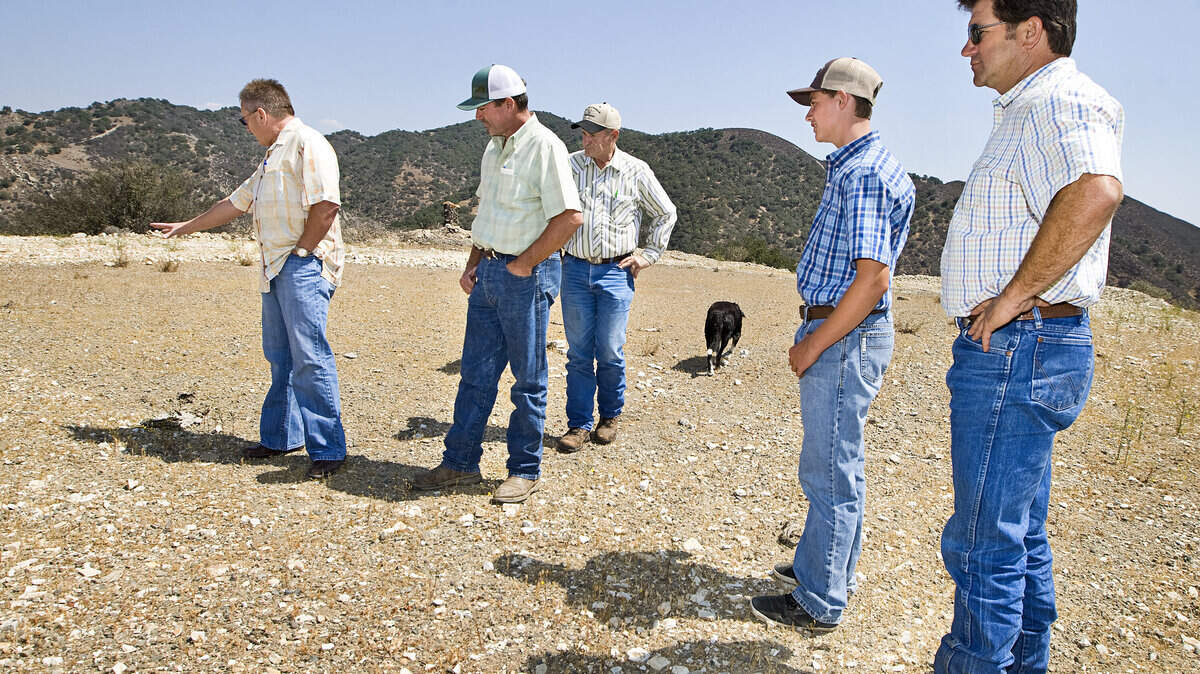
The Porters met with a reporter and photographer recently on their property to share their history, their plans for the ranch and why they’ve leased more than 4,000 acres in a quest for oil.
The ranch is spread over more than 6,800 acres of rolling hills dotted with oaks and chaparral. Over the years, the Porters have cultivated about 70 acres of wine grapes and 200 acres of farmland, the latter of which is leased to two separate farmers who grow squash, peppers and other crops. The Porters also raise beef cattle.
The ranch holds “a lot of history and family ties and emotional connections,” said Analise Porter Merlo, Charlie’s niece. “We want to see it continue and keep it in the family.”
The Porter Ranch is part of a Mexican land grant issued to Isaac J. Sparks in 1843 that spanned more than 22,000 acres. Sparks left his land to three daughters, including Rosa Sparks, who married Arza Porter in about 1870. One of her sons, Isaac James Porter, had a son, William Arza Porter — Charlie Porter’s dad.
William A. “Bunny” Porter married during the Great Depression and moved to the ranch, where his children — two boys and two girls — were born. Charlie Porter moved back to the ranch in the 1980s; his brother, Ike Porter, has lived there his entire life.
Charlie Porter studied animal husbandry (now animal science) at Cal Poly and worked on the ranch for his father for several years before taking over operations with Ike. Charlie and his son, John, also own Alamo Farming Co. in Santa Maria, where they farm 600 acres.
Family members fondly recall growing up on the ranch or frequently gathering there for celebrations, holidays or just to meet up. The family celebrates Thanksgiving and Christmas in their grandparents’ former home, which is unoccupied but used for functions.
Fourteen-year-old Bryce Porter, John’s son and Charlie’s grandson, spent this summer working on the ranch with his older brother. Together the boys fixed fences and worked in the vineyards, weeding and replacing sprinkler heads.
“I’ll probably go into ag somewhere,” Bryce said when asked about future aspirations. “I’ve grown up around it and I feel comfortable in it.”
What lies beneath
For years, the Porters — who retain the mineral rights on their property — have discussed the possibility of oil exploration. When Excelaron proposed drilling as many as 12 oil wells in the Huasna Valley, located 10 miles east of Arroyo Grande, the Porters were excited at the prospect of oil exploration in the county. They weren’t surprised when Alamo Creek LLC approached them.
The corporation holds the lease, and is comprised of Parker and several other investors, including Canadian-based United Hunter Oil and Gas Corp. and a subsidiary of Australian Oil Co. Ltd.
There are three leases, Parker said, two of which cover the Porter Ranch property and another 2,820 acres held by Adam Estate, a separate branch of the family. Parker is most interested in the lease covering 4,068 acres of the Porter Ranch.
“People are looking for oil all over,” Charlie Porter said. “San Luis Obispo County is always holding back for some reason.”
Parker was initially seeking to drill and test up to four exploratory oil and gas wells on two existing pads on the ranch, located off Alamo Creek Road north of Highway 166. No fracking is proposed, a process that involves injecting water and chemicals under high pressure into oil-bearing deposits deep in the earth in order to crack the rock and release oil and natural gas.
Parker recently downsized those plans to drill only one well on one pad in hopes that doing so would lessen concerns about the project. That work would be temporary; Parker would have to apply for another county permit for permanent production.
The Porters didn’t expect to face opposition to their project from Huasna Valley residents. Their land is not in the Huasna Valley, they say, and none of the impacts, from traffic to drainage to noise, would impact Huasna Valley residents. They refer to it as the Alamo Creek area.
“We’re a huge ranch, doing small tests,” Porter Merlo said. “There are literally no impacts.”
Impact on the valley
Huasna Valley residents, however, are concerned that approval of Parker’s project could open the floodgates to other drilling ventures that would change the character of their valley as well as the county.
Porter Ranch is close to two homes — the nearest is about a half-mile away on the eastern edge of the Porter property, and Parker has tried to ease concerns by studying noise, traffic, biological and other impacts of his proposal. The studies were compiled after the county requested additional information.
He’s also proposed to truck in water to avoid using an irrigation well on the Porter Ranch, and offered in a recent interview to pay for residents of the nearby home to stay in a hotel during the drilling period, which he estimated would take about 10 days or less.
Those residents, Marcia Burtt and her husband, David Sowle, who bought their property in 1996, said they hadn’t heard from Parker directly. Burtt’s concerns include the project’s impact on the shared aquifer as well as air quality and visual impacts.
She said they stopped leasing some of their 1,200 acres to organic farmers and for cattle because they weren’t able to pump enough water for those operations.
“That would make a big difference,” Burtt said of Parker’s plan to bring in water, “but it doesn’t solve all of the problems.”
“If anything is built on Pad A, we would be able to see it,” she added. “There’s a reason we want to live here — the air is pure, it’s quiet at night. We don’t want to live at the Four Seasons Resort in Santa Barbara, even for a short time.”
San Luis Obispo County senior environmental planner John McKenzie said staff is still evaluating Parker’s request to reduce the proposal and has not yet determined the level of environmental review needed.
Since the land remains in Williamson Act contracts, the project will also go before the county’s Agricultural Preserve Review Committee. The program allows farmers and ranchers substantial property tax breaks if they sign 10-or 20-year non-development contracts.
Future options
Parker believes it could take another year before he gets to drill a test well — if county officials approve his project — and another three years after that to pursue a permanent project if he determines it’s feasible.
The Porters have clearly put their trust in him and are confident that this project would help preserve the ranch for generations to come.
“When ranches go through generations and there’s no revenue, it’s more likely for them to sell,” said Joe Doud, Charlie’s nephew.
Porter family members are proud of their stewardship of the land. If Parker’s plan doesn’t pan out, they might pursue future options, such as a lease agreement with another oil exploration company, but none would involve fracking, Porter Merlo said.
“We’re going on six, seven generations of Porters on this ranch, and we do have some rights on our property and our minerals,” John Porter said.
This story was originally published August 16, 2014 at 8:52 PM with the headline "Porter family hopes to find oil on ranch it's owned for generations."