SLO could push smaller, denser housing downtown — but it wants your feedback first
The city of San Luis Obispo is looking to increase its stock of high-density housing units — and it’s asking for your feedback on its latest program.
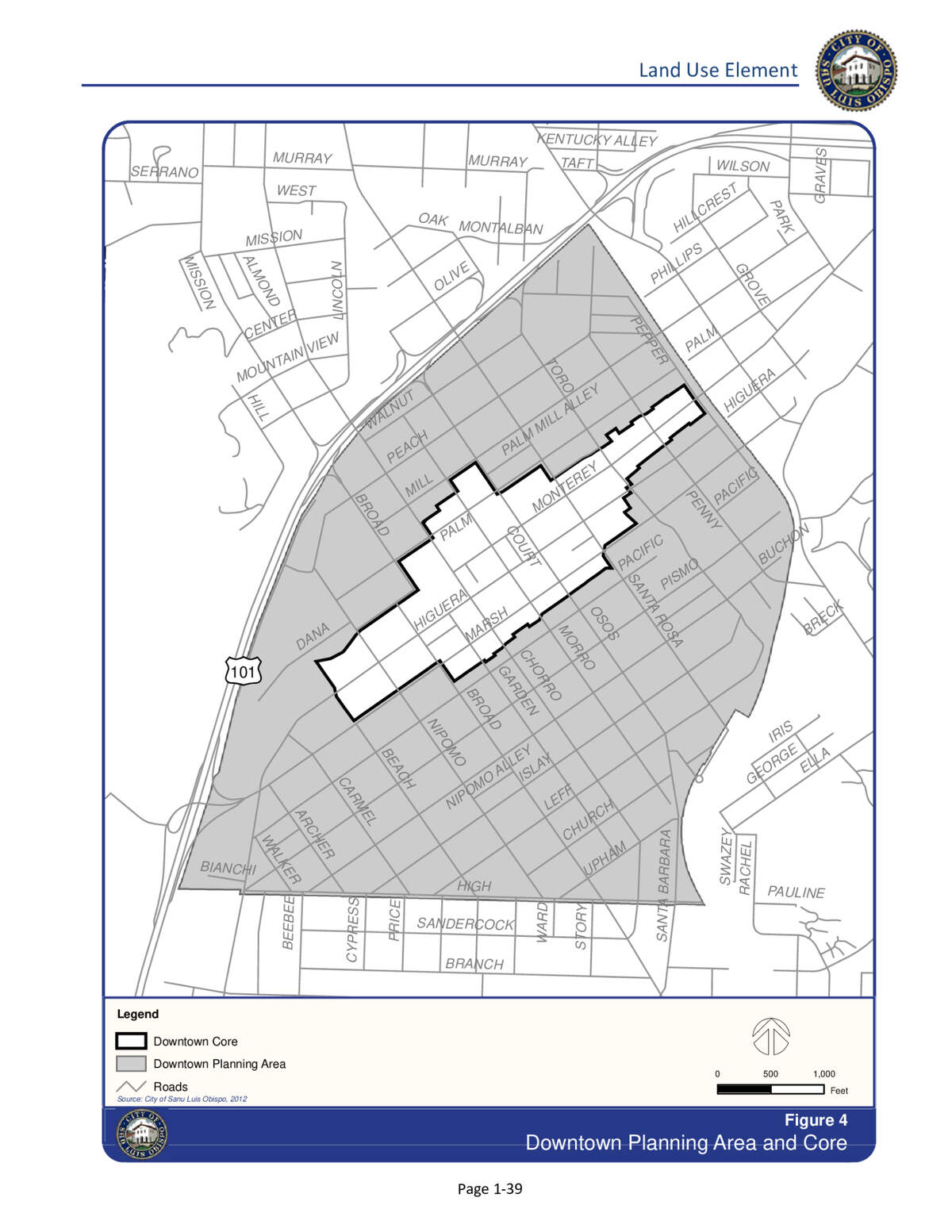
The Draft Flexible Density Ordinance, also referred to as a Downtown Flexible Density Program, would peel back much of the red tape involved in the building process to allow for the construction of 500 high-density units in downtown SLO.
The city is asking for public feedback on the plan through an online forum, which will be open until Feb. 15.
As of Wednesday, the city has already received 135 comments on the plan, Community Development Department Housing Coordinator Kyle Bell told The Tribune.
“Housing has repeatedly been identified as a top priority in community surveys and expanding housing affordability is again identified as a top investment priority for the state of California,” Bell said.
So, what’s in the program? And could it play a role in fixing San Luis Obispo’s chronic cost of living and housing shortage issues?
What could downtown density program accomplish?
At its core, the goal of the Downtown Flexible Density Program is to incentivize the creation of the high-density, low square-footage studio or one-bedroom housing units, defined in the draft ordinance as 600 square feet or fewer.
The limit on these units would be reached when 500 of this size have been built or the program reaches its Jan. 1, 2029 expiration — whichever comes first, according to a draft ordinance of the program.
“The program is intended to facilitate the construction of smaller housing units within the city’s downtown core by relaxing density limitations for qualifying units and providing development standard incentives,” the ordinance read.
Those relaxed limitations come in many shapes, and apply only to the parts of the downtown core zoned as Downtown Commercial (C-D) and Retail Commercial (C-R) development zones, as defined in the city’s Housing Element.
Critically, Bell said, the program changes the density allocation for the qualifying lots, which is the number of housing units that can be built on a property based on its size.
Bell said the city regulates density as a fractional metric, which means that under the existing zoning code, spaces under 600 square feet are equivalent to a half-density unit, compared to a two-bedroom space, which is worth 1 density unit.
In the case of the downtown’s C-R and C-D zones, the base density allowance is 36 units per acre, Bell said.
The proposed program wouldn’t count density for units 600 square feet and smaller, so they would not be subject to the downtown’s zoning base density allowance. Instead the number of units would be limited only by the area of the building.
“The program is intended to encourage the development of smaller units by offering housing developers more ‘flexibility’ from standard density limitations, without imposing any increase to the scale or height of structures within the downtown,” Bell said.
Part of what makes dwellings of this size appealing, Bell said, is how it could change the makeup of who can live downtown.
The average household size in SLO has been declining since the 1990s, Bell said, and as a result, the housing stock accommodates fewer people.
In 2017, Bell said non-family households — like single occupants and roommates — accounted for 60% of all households in SLO, while family households were around 40%.
Meanwhile, a little over one-third of SLO’s housing stock consists of two-bedroom units, another 30% are three-bedroom units and the remaining roughly 20% is made up of studios and one-bedroom units.
Allowing smaller, more dense units downtown would offer more places for those non-family households to rent or buy.
Downtown residents, builder criticize rapid growth
Though the city says the program would benefit residents, others have criticized it saying it could raise costs and bring rapid growth to the city.
Jim Moresco, chief operating officer of the Midland Pacific Building Corporation, said the program would not make high-density construction as viable for builders.
Restricting the program to one-bedroom apartments and studios, Moresco said, will raise the price because of the associated costs of other features like kitchens and bathrooms for every unit.
“If the city allowed this to be two-, three- or four-bedroom units, you could have one kitchen and one or two bath(s) for every two-to-four bedrooms in the building, greatly diluting the cost,” Moresco said. “Ask yourself, who usually pays cheaper rent, the person living by themselves, or the person living with three other roommates?”
There are some aspects the city got right, Moresco said, including the emphasis on workforce apartments.
Condos are far more likely to be snapped up by wealthier buyers, he said, and don’t typically cater to the type of customer these higher-density units are intended for.
“This is a decent start for the city because it shows they acknowledge there is a problem,” Moresco said. “I would be very surprised if this changes anything if passed in its current form.”
The open forum the city opened online for the proposed program yielded a range of results — some positive and some negative.
One San Luis Obispo resident said the city needs better public transportation, like buses and scheduled lines between neighboring cities, in order to accomplish a future independent of cars.
No new homes in San Luis Obispo are affordable, the resident said, or low-income.
“New units ALWAYS rent or sell for higher prices that only transplants or people who already have higher incomes can afford,” the post read. “So, thinking that this will somehow alleviate the problem of the skyrocketing cost of housing is delusional. The only thing that will help that is legislation on rent, legislation on corporate ownership of homes, and legislation prioritizing current residents in both home sales and rentals.”
Other residents criticized higher density in the downtown core, and criticized the removal of inclusionary housing ordinance (IHO) requirements from the high-density units.
While high-density housing downtown makes sense, another resident said, the IHO exemption was “inconsistent with the overall city plan of providing affordable housing.”
“Allowing higher density makes these projects more profitable for developers because they can sell more units and would be motivation enough for these projects to get built,” the post read. “These new units will likely increase the cost per square foot because people looking to buy or rent will be willing to pay equivalent rents for these smaller units simply due to a lack of supply. This will then drive up the costs for all other existing larger units.”
Bell said because gaining as many smaller units as possible was the goal, removing exemption from the IHO was necessary.
“All units under 600 square feet in the downtown core would qualify under the Flexible Density Program and, as proposed, the program would exempt only the qualifying units from the requirements of the IHO,” Bell said.
Other residents took issue with the parking exemption, which one resident felt will increase frustrations with parking downtown.
Without adequate public transportation systems to replace the reliance on cars, another resident said, transportation problems will worsen.
“This exemption will further impact available parking and create pressure on an already difficult parking environment,” the post read. “In the meantime, the frustrating lack of parking for residents and businesses will escalate.”
Supporters of program praise benefits of increased housing stock
One lifelong resident said more housing of all kinds is needed, and thanked the city for its implementation of protected bike lanes and lack of parking requirements.
“I’m 59, born and raised here, family here for 6 generations,” the post read. “We need more change in our city and less negativity from all the complaining ‘long-term residents.’ BUILD BABY BUILD.”
Another resident said adding housing is necessary to allow the community to thrive, and said the lack of affordable housing is harming residents who are being priced out.
“Why is it that we continue to debate this topic?” the post read. “The only valid and acceptable answer is yes, anything else is a selfish and sad demand. We should all be in agreement that all deserve to not just live in our community but thrive, why should we let anyone get in the way of this happening.”
The importance of putting housing close to businesses was also top of mind.
As one resident pointed out, market-rate and income-restricted units downtown would help stimulate the local economy.
“Our local businesses will thrive with more residents in walking distance, and those already living downtown will benefit from more eyes on the street as well,” the post read.
Cal Poly students also weighed in on the proposal.
The university recently enrolled its largest-ever class of on-campus residents in the fall 2022 semester, taking on 8,314 students — 200 more students than the previous fall semester.
“I want to see more housing in downtown SLO,” a student said in a post. “As a college student, housing is scarce and unaffordable. We need density to allow for housing for all and strong, connected communities.”
Cal Poly’s impact on local rent and housing affordability is not negligible, residents said in August, though the university has a master plan in place to add to its housing stock.
Still, that problem affects both students and permanent residents alike, Cal Poly Democrats said in a post on the city’s online forum.
“As students, we suffer greatly from the lack of affordable, high density housing in SLO,” the post read. “We are advocating for an increase in high density housing in SLO City. Increased housing stock will benefit both the student and permanent resident population greatly.”
Housing activists view program as ‘great start’
Krista Jeffries, a housing activist and organizer for SLO County Yes In My Back Yard (YIMBY), said the flexible density program could be a “great start” toward enabling people to live where they work.
“The downtown used to house over 5% of SLO’s population in 1950, and now it’s down to less than 1%,” Jeffries said. “The area needs housing, particularly for single-person households. But there’s really no ‘wrong’ kind of housing for downtown, except single homes on large lots.”
Larger families need more space, Jeffries said, while two- and three-bedroom apartments are good for younger families or work-from-home couples.
There’s no reason the downtown area should only be studios and one-bedroom apartments, Jeffries said, but the city’s diversity, equity and inclusion goals could be achieved by applying the square foot limit as an average across all units in the building.
In this proposed case, if a developer built a five-unit building with two 600-square-foot units, one 800-square-foot unit, another unit at 1,200 square feet and another at 1,500 square feet, that’s an average square footage of 940.
“You’d have a more diverse neighborhood in that one building than you would if it was 20 units that are all 600 square feet, and it would allow building plans to flex a little bit if market conditions drastically changed during construction.”
The program isn’t perfect, Jeffries said; because it only applies to lots in the C-R and C-D areas, it only applies to about half the land in the downtown core.
Additionally, Jeffries said the parking requirements in the city are still too high.
Jeffries said the public response to the bill was about what she expected from many housing debates around the city of SLO.
“To me, the feedback looks much the same as it’s always been: dominated by those who have housing already and think environmentalism equates to their personal view of Madonna Mountain,” Jeffries said. “Only this time, I’m seeing much more pro-housing voices, and that is encouraging. As to what I would say to those who disagree with more housing downtown, I would invite them to cry louder.”
Any interested residents can comment on the program until Feb. 15 at 11:59 p.m. at the forum website.
The San Luis Obispo Planning Commission is expected to discuss the program Feb. 22, with a City Council hearing set for March 21.
This story was originally published January 26, 2023 at 1:05 PM.