
SLO County cemeteries are alive with history
Whenever Halloween approaches, people often associate cemeteries with zombies digging out of their graves or transparent souls wandering through tombstones.
But while the notion of hundreds or thousands of dead people lying in one place is ripe for scary stories, graveyards are also fascinating sites that tell us much about history — for instance, that the 1880s were not a good time to be a baby around here.
Smaller, older cemeteries are especially intriguing because they feature a throwback look that channels not the dead but stories of their time and place.
We recently visited a sampling of the smaller cemeteries in San Luis Obispo County, seeking to learn more about local history. As it turns out, the dead do speak— just not as ghosts or zombies.
CANET FAMILY CEMETERY | MORRO BAY
Vicente Canet, a Spaniard of the province of Valencia, came to Monterey, Calif. — then part of Mexico — as a member of the Spanish Royal Navy in 1824. As he was preparing to become a citizen of Mexico — which had successfully revolted against Spain — Canet discovered Rancho San Bernardo in Morro Bay and settled down in his new home.
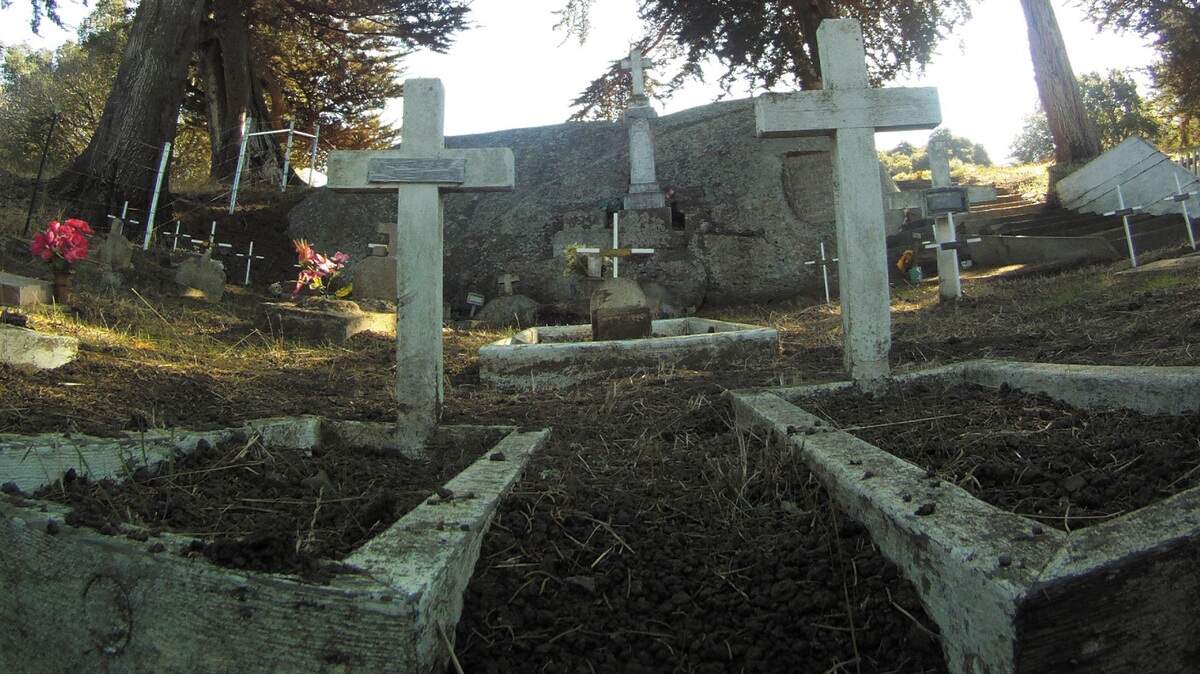
While Canet is long gone, his family’s cemetery still remains in the shadow of Hollister Peak. Here two of the tombstones are built into a large boulder, and a roster lets visitors know who is buried here, with a hand-drawn map showing where to find the graves.
Of the 55 names listed, 11 are babies.
SAINT PATRICK’S CEMETERY | ARROYO GRANDE
Located in the shadow of Walmart and adjacent to the Oak Park Professional Centre, you can smell fast food as you walk through this forgotten old Catholic graveyard, featuring many broken or tipped-over tombstones. While it might seem like there are many available spaces here, many of the seemingly empty plots are actually unmarked graves.
In contrast to the neatly manicured Arroyo Grande District Cemetery not far away, this one, dating to 1887, features dead grass, gopher holes and gravel.
Many of the people buried here came from the Azores, islands located in the North Atlantic, 2,400 miles from the East Coast. Earthquakes in the 1800s prompted many Azores residents to move to the coast of California, which resembled their homeland.
Former residents of Portugal and Ireland are also well represented here.
The starkest visual here is a large sculpture of Christ on a cross that adorns the grave of the Rev. Father Michael Lynch. According to the San Luis Obispo County Genealogical Society — which provides much of the information available on local cemeteries — Lynch, born in Ireland, was the first priest and rector of Arroyo Grande and died of pneumonia in 1903 at age 62.
ESTRELLA ADOBE CEMETERY | PASO ROBLES
In 1878, early pioneers built the first Protestant church in northern San Luis Obispo County, only to see it fall upon hard times a few years later due to drought and disease. By 1903, it was hardly used, though it would be rebuilt five decades later.
In the lonesome cemetery beside it, the ground is covered in pine needles, while aging tombstones often lean to one side. In an adjacent vineyard, a white scarecrow waves in the wind like a ghost.
The most recent burial here occurred in 1938. Interesting “residents” include Thomas Rude, a Kentucky native, who was dragged to death by a horse in 1882. Former Confederate soldier Edmund Morris (1832-1907) is buried here, as are the Sinclair children — Edward, 8, Daniel, 4, and Ernest, 2 — who all died within three months of each other in 1884 and 1885, reflecting a diphtheria outbreak. Although he’s not buried here, there is a marker for August Wolf, which proclaims “Lost at Sea” — reflecting a tragic fishing accident from 1931.
The SLO County Genealogical Society has put together a nice list of graves here, which can be seen near the church.
PARKFIELD CEMETERY | PARKFIELD
Located near the famed San Andreas Fault, northeast of San Miguel, the Parkfield Cemetery is a chronicle of heartbreak. With no sign at the entrance, no grass and no noise, this cemetery marks a forgotten place, an Old West-style graveyard where intense summer heat discourages visitors and dries out the soil.
Many of the 94 bodies buried here once belonged to children who died from the diphtheria outbreak in the 1880s. Also here is the tombstone of Louisa Kidwell Lee, who died in 1893, According to her tombstone, she was the granddaughter of the Rev. Jonathan Kidwell, a soldier in the American Revolution.
ADELAIDA CEMETERY | ADELAIDA
Talk of Adelaide Cemetery usually pops up during Halloween, because it’s this graveyard that spawned the legend of the Pink Lady, also known as Charlotte Sitton, a 19-year-old buried in 1890. According to legend, Sitton’s ghost, dressed in pink, wanders the cemetery every Friday night, grieving for the two children (or one, depending on which version of the story you hear) she lost to diphtheria in the 1880s.
Aside from the ghost talk, this cemetery, perched on a hill with lots of trees, represents a peaceful place to lie in eternal rest.
CAMBRIA COMMUNITY CEMETERY | CAMBRIA
Leave it to quirky Cambria to have the most interesting cemetery in the county. While it’s still very active — and larger than the others in this list — it’s also historic, with its oldest resident having been born in 1798. Located amid the largest strand of Monterey Pines in California, this heavily wooded cemetery is aplace where survivors have gotten creative with wind chimes, bronze dogs and stained glass.
One tombstone features the names of four Japanese abalone divers, who perished, according to former cemetery manager Doug Spelts, when they lost the air supply to their diving helmets in 1910. There’s a Confederate soldier buried here — Thomas Bingham, who laid out the cemetery — and a World War I vet who was with the balloon unit of the Army, Spelts said.
But this is the one cemetery where the more recent graves are just as interesting as the old ones. Encouraged by flexible cemetery rules, loved ones have left bags of photos, unopened cans of beer, a tiny needlepoint village, an anchor and a football, to name a few of the interesting items.
Contrasted with those, some graves are simply marked with a rock and a painted name. Many of the dead — including those in the old segregated Chinese section — aren’t even named, though in some cases markers have been added, stating, “Lost in name but not in spirit.”
SANTA ROSA CEMETERY | CAMBRIA
Located high on a hill above town, this cemetery lacks the flair of its neighbor, the Cambria Community Cemetery, but it packs in lots of history.
The restored cemetery chapel, built in 1870, was the first Catholic church built in California after the missions. During its working years, which lasted until the early 1960s, the chapel saw famous visitors, according to the Cambria Historical Society, including William Randolph Hearst, Gary Cooper and Bing Crosby. The graveyard itself features three Oscar winners (for sound), in addition to some of the town’s founding members.
The wooden markers here — shaped like antiquated Hawaiian alaia surfboards — dramatically dot the yard while moss hangs from graveyard trees, as if placed there by a Hollywood set designer.
Near the chapel, there’s a mass grave, where residents buried their stillborn babies between 1871 and 1947.
This story was originally published October 31, 2011 at 1:11 AM with the headline "SLO County cemeteries are alive with history."