SLO County has the worst air quality in the world. How bad is the smoke in your town?
San Luis Obispo County had the worst air quality in the entire world Thursday as smoke from wildfires in the Bay Area poured south to the Central Coast, blocking the sun and darkening skies.
The conditions were worst in the North County, which was blanketed in a choking haze throughout the day.
“I can’t remember a time in my 30 years where (the poor air quality) was this widespread for this long,” San Luis Obispo County Air Pollution Control officer Gary Willey said.
And San Luis Obispo County’s Air Pollution Control District data backed up what Willey said. According to the APCD, which began monitoring tiny particulate matter in 1999, data shows that Wednesday reported the worst air quality in the county in at least the past 21 years.
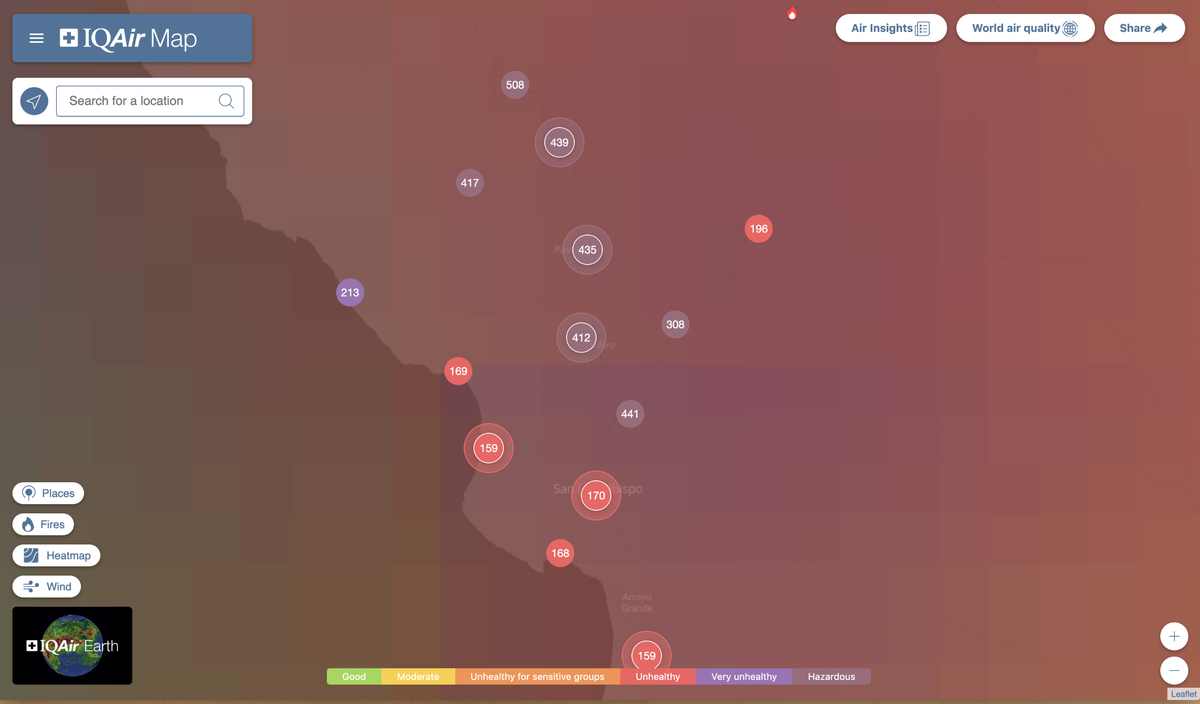
The conditions were so bad that at noon, four North County locations held the top four spots for the worst air quality in the United States, according to IQAir, an air quality monitoring company.
Paso Robles was ranked No. 1, followed by San Miguel, Atascadero and Lake Nacimiento on the top 10 list for the most hazardous air quality in the nation.
IQ Air calculates its air quality index by looking at the six most common pollutants — including particulate matter, carbon monoxide, sulfur dioxide, nitrogen dioxide and ground level ozone — and calculating the health risk for each. The overall AQI is determined by the most present and “riskiest” pollutant, according to IQAir.
The index rating is measured on a scale from 0 to 500, with anything over 300 being considered hazardous, and anything under 50 considered good air quality.
As of noon Thursday, Paso Robles’ index rating was 453, according to IQAir.
San Miguel followed at 428, ahead of Atascadero at 423 and Lake Nacimiento at 417.
One monitoring station in Bradley, in southern Monterey County, apparently registered off the charts, at 508.
Residents avoid smoky air
The poor air quality forced residents to hunker down inside, even more so than they might have under normal COVID-19 restrictions.
That was especially apparent in downtown Paso Robles, which was quieter than normal Thursday as dense haze shrouded the streets.
Smoke was so thick and low that visibility was reduced to as little as a few blocks on Spring Street, where drivers navigated the haze with their headlights on.
The smoke filled downtown, making it difficult to breathe, even with cooler temperatures and a gentle breeze.
A few people dined outdoors, shopped and took their dogs for walks while coping with the smoke.
Kaitlyn Burson said she’s lived in the Paso Robles area for 22 years, most of her life, and has never seen conditions like this. She said she’s been coping with asthma and feels like the smoke is adding to the recent humidity.
“We’ve just been trying to get through it as best we can,” Burson said.
Omar Severiano said he saw worse conditions when he was in Carpinteria during the 2017 Thomas Fire.
Severiano said his family members work at Paso Robles restaurants that have been offering outdoor dining during coronavirus restrictions preventing customers from dining inside.
Severiano’s family members have continued to bus tables outside, although some of the eateries have shifted to take-out only due to the smoke, he said.
He’s been thinking about leaving Paso Robles and heading down to the Santa Barbara area, where he’s heard the smoke isn’t as bad. But he thinks he’s starting to see the smoke clear a bit.
“It’s getting kind of tough,” Severiano said. “The weather and the virus and the smoke.”
Worst air quality in the world
The air quality in the North County got progressively worse as the day went on. Atascadero, for example, moved up from No. 9 to No. 3 on the IQAir list from a reading of 305 at 10 a.m.
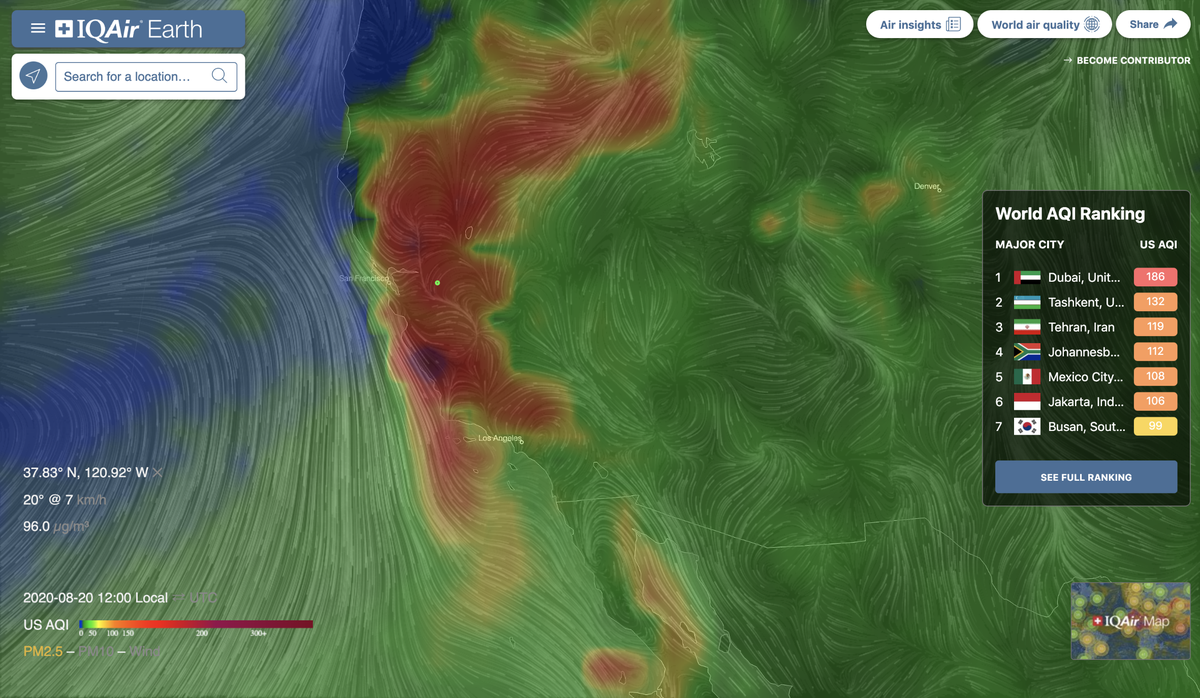
To put the severity of these levels in perspective, the IQAir ranking of the most polluted big cities in the world was topped Thursday by Dubai at an AQI of 186.
The website’s real-time 3-D animated model, IQAir Earth, showed a dark purple blob squarely over SLO County. It was the densest reading anywhere on the global map.
San Luis Obispo County has experienced smoky skies, hot temperatures and unhealthy air quality since Tuesday, when the San Luis Obispo County Air Pollution Control Board and county Public Health Department issued an air quality alert.
However, air quality in San Miguel, Paso Robles, Lake Nacimiento and Atascadero has surpassed unhealthy and reached hazardous levels due to small particulate matter, known as PM 2.5, according to IQAir.
The dangerous increase in particulate matter was caused by smoke from fires burning in Monterey County.
According to the California Air Resources Board, an average of 35 micrograms per cubic meter is the maximum exposure to PM 2.5 people can have over a 24-hour period before they begin to experience health issues.
PM 2.5 exposure for even a 24-hour duration, has been associated with heart and lung issue, acute and chronic bronchitis, asthma attacks, emergency room visits, respiratory symptoms, and restricted activity day — especially for children, older adults and people with preexisting conditions, according to the air resource board. PM 2.5 is even small enough to travel through the respiratory system into the lungs and bloodstream.
An air quality monitor at Camp Roberts in San Miguel reported a PM 2.5 level of 295.2 micrograms per cubic meter around 9 a.m. Another monitor on Vista Grande Street in Paso Robles reported 263 micrograms per cubic meter.
Monitors around the county have reported high rates of PM 2.5 levels in the hundreds since Wednesday.
APCD senior air quality specialist Karl Tupper said that air quality monitors in Atascadero had the highest PM 2.5 levels the county has ever recordeed, but Thursday’s levels could be worse.
The previous 24-hour average record was 57 micrograms per cubic meter in Atascadeo. Wednesday’s 24-hour average more than doubled that with a record of 135 micrograms per cubic meter.
“It is the worst we’ve ever recorded anywhere in the county, but the day is not over yet, “ Tupper said.
“Today’s 24-hour average for Atascadero will almost surely be even higher,” Tupper wrote in a followup email.
San Luis Obispo also had record high PM 2.5 levels Wednesday, Tupper said. Wednesday’s 24-hour average was 65 micrograms per cubic meter.
Tupper also noted that the levels of PM 10, which are larger particulates, were also elevated significantly in Paso Robles, Atascadero and San Luis Obipo.
The air quality was bad across the county, but substantially better than the North County. San Luis Obispo posted a AQI of 172 at noon, while Morro Bay was at 162, Cambria was 193 and and Nipomo was 170.
IQAir looks at levels of PM 2.5 and a larger grade of particulate matter, PM 10, in determining its air quality rankings.
Three large fires in south Monterey County have led to smoky and unsafe conditions in San Luis Obispo County.
The Dolan Fire near Big Sur, which began Tuesday night, had burned 2,500 acres and was 0% contained as of Thursday morning, according to the Los Padres National Forest Service.
The River Fire near Salinas, which began Sunday, had grown to 33,653 acres as of Thursday morning, Cal Fire reported. That wildfire was 7% contained, according to Cal Fire.
And the Carmel Fire near Carmel reached 4,385 acres as of Thursday morning and remained 0% contained.
How to stay safe in unhealthy air quality
Children, older adults and people with existing respiratory illness and heart conditions are particularly vulnerable to poor air quality.
The San Luis Obispo County Air Pollution Control District warned that if anyone smells smoke or sees ash falling from the sky, they should take the following precautions:
- Head indoors and remain indoors, if possible;
- Avoid strenuous outdoor activity;
- Close all windows and doors that lead outside to prevent bringing additional smoke inside; and
- Stop any outdoor activity immediately and seek medical attention if experiencing a cough, shortness of breath, wheezing, exhaustion, light-headedness or chest pain.
Although the use of masks is encouraged to protect from COVID-19, a cloth mask will not protect from inhaling wildfire smoke, the ACPD said.
This story has been updated with the latest air quality index readings from iqair.com and with APCD information about record-breaking particulate matter levels.
This story was originally published August 20, 2020 at 10:34 AM with the headline "SLO County has the worst air quality in the world. How bad is the smoke in your town?."